
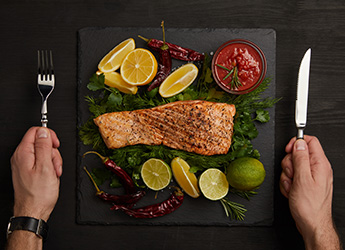
 The lowly microalgae in the ocean produce astaxanthin for their protection against environmental stressors and light. Fish and crustaceans consume microalgae and retain the bright red color that we see in salmon, sea trout, shrimp, and krill.
When we enjoy savory salmon, the benefit of the astaxanthin that it contains extends to our vision, brain, circulatory system, immune system, etc., but with a difference. It provides significantly greater antioxidant protection (10x to 100x more) than other antioxidants.[1. Chiro.org. Antioxidants: Relative Singlet Oxygen Quenching Rates. Retrieved Apr 16 2018 from http://www.chiro.org/nutrition/FULL/Antioxidants_Relative_Singlet_Oxygen_Quenching_Rates.html.] [2. Kurashige M, et al. (1990). Inhibition of oxidative injury of biological membranes by astaxanthin. Physiol Chem Phys Med NMR. 1990;22(1):27-38.] [3. Rodrigues E, et al. (2012). Scavenging capacity of marine carotenoids against reactive oxygen and nitrogen species in a membrane-mimicking system. Mar Drugs. Aug;10(8):1784-98.]
Astaxanthin Sources
Our bodies do not produce astaxanthin – we can only get it from our diet or supplements. The best food sources of astaxanthin are wild sockeye salmon, rainbow trout, and coho salmon. Other salmons and chars provide astaxanthin in lesser quantities. The astaxanthin that comes from natural sources offers more than 20 times more protection than synthetic astaxanthin.[4. Capelli B, et al. (2013). Synthetic astaxanthin is significantly inferior to algal-based astaxanthin as an antioxidant and may not be suitable as a human nutraceutical supplement. Nutrafoods. Dec 1;12(4):145-52.] One of the best supplemental sources of commercially available natural astaxanthin comes from the microalgae Haematococcus pluvialis.[5. Ambati RR, Moi PS, Ravi S, Aswathanarayana RG. (2014). Astaxanthin: Sources, Extraction, Stability, Biological Activities and Its Commercial Applications–A Review. Mar Drugs. Jan;12(1):128-152.]
Astaxanthin is fat-soluble; absorption rates markedly improve in the presence of fish oils (as in salmon). If you take astaxanthin as a supplement, take it with or immediately after a meal that contains a little oil.
Astaxanthin Roles
Because of its unique molecular structure astaxanthin is one of few antioxidants which can move throughout the entire body. Its benefits are broad, including the ability to protect both within and outside cell membranes, inhibit oxidation of fats, enhance the immune system, regulate gene expression, inhibit inflammation, reduce oxidative stress, protect cellular integrity,[6. Ibid. Ambati. (2014).] and protect against mitochondrial (cell’s energy source) dysfunction.[7. Kuroki T, Ikeda S, Okada T, Maoka T., Kitamura, A., et al. (2013). Astaxanthin ameliorates heat stress-induced impairment of blastocyst development in vitro: –astaxanthin colocalization with and action on mitochondria. J Assist Reprod Genet, Jun;30(5):623-31.]
Its ability to protect from oxidative damage arising from exposure to blue and blue-violet light is critical for retinal and macular health. Similarly, its protection against inflammation and resulting oxidative stress are important for the body, the eye, and the brain.[8. Sakhri S, Aneva IY, Farzaei MH, Sobarzo-Sanchez E. (2019). The Neuroprotective Effects of Astaxanthin: Therapeutic Targets and Clinical Perspective. Molecules. Jul 20;24(14):2640.]
Astaxanthin in the Brain
Astaxanthin is able to cross the blood/brain barrier and so can deliver antioxidant protection directly to our brain. In fact, the brain is considered to be the most important target of this powerful antioxidant. It is of great interest to neurophysiologists for its positive effect on neurodegenerative conditions like Alzheimer’s, Parkinson’s, and Huntington’s diseases.[9. Galasso C, Orefice I, Pellone P, Cirino P, Miele R, et al. (2018). On the Neuroprotective Role of Astaxanthin: New Perspectives? Mar Drugs. Aug;15(8):247.] For example, astaxanthin reduces hippocampal inflammation in the brain.[10. Zhou X, Zhang F, Hu X, Chen J, Wen X, et al. (2015). Inhibition of inflammation by astaxanthin alleviates cognition deficits in diabetic mice. Physiol. Behav. 2015;151:412z420.] It accumulates in the cerebral cortex which may help maintain and improve cognitive function[11. Manabe Y, Komatsu T, Seki S, Sugawara T. (2018). Dietary astaxanthin can accumulate in the brain of rats. Biosci Biotechnol Biochem. Aug; 82(8):1433-1436.] and inhibits premature cell death and nerve damage.[12. Kim SH, Kim H. (2019). Astaxanthin Modulation of Signaling Pathways That Regulate Autophagy. Mar Drugs. Oct;17(10):546.]
Eye Fatigue
In a number of different studies, researchers found that astaxanthin was useful in reducing fatigue, sore dry eyes, blurry vision, and recovery from intense visual stimulation (such as a TV or computer screen.[13. Nakamura A, Isobe R, Otaka Y, Abematsu Y, Nakata D, et al. (2004). Changes in Visual Function Following Peroral Astaxanthin. Japan J Clin Opthal, 58(6):1051-1054.] [14. Nitta, T., Ogami, K., Shiratori, K. (2005). The effects of Astaxanthin on Accommodation and Asthenopia-Dose Finding Study in Healthy Volunteers. Clin Med, 21(5):543-556.] [15. Nagaki Y, Mihara M, Tsukuhara H, Ohno S. (2006). The supplementation effect of astaxanthin on accommodation and asthenopia. J Clin Therap Med, 22(1):41-54.] In computer users, astaxanthin was found to significantly improve accommodation amplitude, which refers to the ability of the eye to change focus as distances change.[16. Nagaki, Y, Hayasaka, S, Yamada, T, Hayasaka, Y, Sanada, M, et al. (2002). Effects of astaxanthin on accommodation, critical flicker fusions, and pattern evoked potential in visual display terminal workers. J Trad Med, 19(5):170-173.]
Diabetic Retinopathy & Diabetic Cataracts
The origins of diabetic eye disease lie in changes in and cell death (apoptosis) of nerve cells in the retina. Astaxanthin reduces apoptosis of retinal ganglion nerve cells in lab animals with diabetes mellitus. It further accomplishes this by reducing oxidative stress, inflammation, and other measurable visual functions via electroretinogram in the retina.[17. Dong LY, Jin J, Lu G, Kang XL. (2013). Astaxanthin Attenuates the Apoptosis of Retinal Ganglion Cells in db/db Mice by Inhibition of Oxidative Stress. Mar Drugs. Mar;11(3):960–974.] Astaxanthin also reduces diabetic-related cataract formation in lab animals by delaying development and progression of metabolic cataracts.[18. Yang M, Chen Y, Zhao T, Wang Z. (2020). Effect of astaxanthin on metabolic cataract in rats with type 1 diabetes mellitus. Exp Mol Pathol. Apr;113:104372.]
Macular Degeneration
The value of lutein, zeaxanthin and mesozeaxanthin in preventing macular degeneration are well known. Investigations of the antioxidant effectiveness of astaxanthin in the retina are quite promising. A major cause of macular degeneration is oxidative damage due to exposure to blue and blue-violet light. Studies indicate that astaxanthin protects against light-induced damage in the retina.[19. Otsuka T, Shimazawa M, Nakanishi T, Ohno Y, Inoue Y, et al. (2013). Protective effects of a dietary carotenoid, astaxanthin, against light-induced retinal damage. J Pharmacol Sci. 123(3):209-18.] Improvements in AMD indicators are even greater when astaxanthin is combined with lutein and zeaxanthin.[20. Parisi V, Tedeschi M, Gallianaro G, Varano M, Saviano S, et al. (2008). Carotenoids and antioxidants in age related maculopathy, Ophthalmology, Feb;115(2):324-333.e2.]
- We recommend Jarrow’s Astaxanthin, 12mg as a good source for natural astaxanthin.
- It is a key ingredient in our Meso Plus Retinal Support Formula with Astaxanthin.
- For computer eye strain: Computer Eye Strain Package 1.
- For inflammation: Anti-Inflammatory Eye and Whole Body Package 1.
- For night vision/blue light: Blue Light Protecting/Night Vision Package (2 month supply).
- For macular degeneration: AMD Package 1 (3 month supply).
- For Stargardt’s: Stargardt’s Package 1 (3 month supply).
Please call us at 845.475.4158 if you have questions.