 Scientists are putting significant focus on Age-Related Macular Degeneration in their research. This eye disease strikes mostly older adults, over aged 50. The “Baby Boomer” generation is well above age 50, as are their living parents. Understanding the causes and potential treatments for Macular Denegation (ARMD) are important, because vision-impaired elderly people need extra help with their daily activities. Also, quality of life is lowered when vision is poor.
The macula is a tiny yellowish spot in the back of the eye, on the retina. It allows for central vision. Central vision is possible because of the macula. If it breaks down, reading, writing, watching TV, cooking, driving and even facial recognition are impaired. Macular Degeneration is degenerative, meaning that it gets worse over time.
ARMD comes in two forms. The more common Continue reading “AMD Research – Part 2”
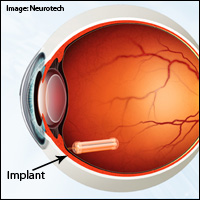 Clinical trials are underway for an implantable device that delivers medication directly to the eyes of people with
  Women with specific genes may be more likely to develop age-related macular degeneration (AMD) if they are deficient in Vitamin D, according to new research in JAMA Ophthalmology.
 Many advances in technology that could improve the lives of blind people are on the horizon. Solutions that were thought impossible not long ago are now becoming a reality for many patients suffering from retinal diseases. Treatments such as gene therapy, stem cells, and bionic retinas have shown that vision loss can in fact be reversible.