GLA Improves Comfort in Contact Lens-Related Dry Eye

A dry eye study, shows that a group using GLA showed a significant improvement in the specific symptom of “dryness” at 3 and 6 months (p <0.01) as well as significant improvement in overall lens comfort at 6 months (p<0.01). Tear meniscus height was increased in the GLA group at 6 months relative to baseline (p<0.01), although all other objective signs were unchanged

GLA (gamma-linolenic acid) is an omega-6 unsaturated fatty acid made in the human body from linoleic acid, an essential fatty acid found in vegetable oils and egg yolks. GLA has anti-inflammatory properties and can also be found in oils derived from black currant seeds and the evening primrose plant.

Several small trials testing GLA and linoleic (LA) oil in dry eye syndrome with an inflammatory component report reduced ocular surface inflammation and symptom improvement.

Related Studies:
1. Barabino, M et al. Systemic linoleic and gamma-linolenic acid therapy in dry eye syndrome with an inflammatory component. Cornea 22:97–101, 2003.
2. Aragona P, et al. Systemic omega-6 essential fatty acid treatment and PGE1 tear content in Sjogren’s syndrome patients. Invest Ophthalmol Vis Sci 46:4474–9, 2005
3. Kokke KH, et al. Oral omega-6 essential fatty acid treatment in contact lens associated dry eye. Contact Lens Anterior Eye 31:141-6, 2008.
4. Macri A, et al. Effect of linoleic acid and gamma-linolenic acid on tear production, tear clearance and on the ocular surface after photorefractive keratectomy. Graefes Arch Clin Exp Ophthalmol 241: 561-6, 2003.

For more information on dry eyes and natural ways this eye condition can be helped, go to Natural Eye Care
Eye Conditions section and click on Dry Eyes.
Some sight restored with artificial bionic eye

The 73-year-old, known only as Ron, had the experimental surgery seven months ago at London’s Moorfields Eye Hospital and is now able to see flashes of light, follow white lines on the road, and sort grey and black socks.

The eye known as the Argus II, which was developed by US company Second Sight, uses a miniature camera mounted on glasses to transmit images to the back of the eye.

An “artificial retina” consisting of an array of electrodes sends messages along the optic nerve to the brain.

So far 18 patients around the world have undergone the surgery as part of trials and Ron, who lost his sight in his forties due to the hereditary eye disorder retinitis pigmentosa, was one of three patients to have the device fitted at the London hospital.

As he starts to get use to the device his life will be transformed even more as he gradually learns how to use the artificial eye.

He said: ‘For 30 years I’ve seen absolutely nothing at all, it’s all been black – but now light is coming through.

‘It gives me grades of bright light to black and anything in between. I can actually sort out white socks, grey socks and black socks.’

Update, Another Bionic Eye Report

Bionic Vision Australia (BVA) has unveiled its wide-view neurostimulator concept – a prototype bionic eye that will be implanted into Australia’s first recipient of the technology. BVA says that the prototype will deliver improved quality of life for patients suffering from degenerative vision loss caused by retinitis pigmentosa and age-related macular degeneration. The implant, which consists of a miniature camera mounted on glasses that captures visual input, transforming it into electrical signals that directly stimulate surviving neurons in the retina, is currently undergoing testing. Says BVA, the device will enable recipients to perceive points of light in the visual field that the brain can then reconstruct into an image.


Macular Degeneration Vision Improved with Implantable Telescopes

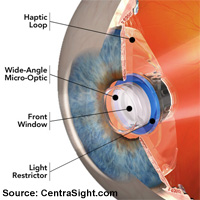
centrasight implantable telescope AMDCentraSight Implantable Telescope

The CentraSightTM treatment program has introduced a tiny implantable telescope  to improve central vision loss caused by ARMD. Though there is no cure for AMD at this time, nine out of ten patients in a clinical trial reported visual improvement and quality of life.

ARMD is the leading cause of vision Continue reading “Macular Degeneration Vision Improved with Implantable Telescopes”