
 Corneal abrasions are scratches on the outermost part of the eye. Sometimes a painful injury is the clear cause. Other times, symptoms can build slowly over a few hours. A corneal abrasion causes so much discomfort that sufferers should seek medical care quickly. The scratch can become infected and cause serious damage in as little as 24 hours. Therefore, recognizing a corneal abrasion could save your sight.
The cornea has 6 layers, and it is very sensitive. It helps the body regulate tear production. The cornea sends signals to the brain to direct it to tell the lacrimal glands whether more or less tears are needed every moment.
Symptoms of Corneal Abrasions
The primary symptom Continue reading “Corneal Abrasions on the Eye: A Guide by Natural Eye Care”
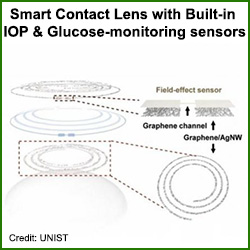 Diabetics and glaucoma patients could start wearing comfortable smart contact lenses to monitor blood sugar and intraocular pressure. Professor Jang-Ung Park and colleagues in South Korea[1. Ulsan National Institute of Science and Technology(UNIST). “‘Smart contact lens sensor’ for diabetic and glaucoma diagnosis.” ScienceDaily. ScienceDaily, 4 May 2017] have solved some of the problems associated with smart contact lenses by using graphene. They recently released a study documenting their breakthrough research. These biosensors may have broad applications for detecting and treating disease.
 Research is pointing toward a link between myopia and the brain chemical dopamine. All-natural sunlight may be the antidote.
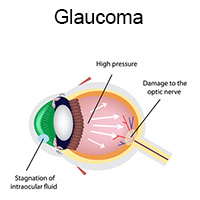 A new “smart” contact lens has been shown to detect accurately intraocular pressure in glaucoma patients. This technology may be useful for predicting which patients are deteriorating rapidly. Their treatment plan can be modified accordingly to help preserve more vision.
 Myopia, also called “nearsightedness,” is a common eye condition that requires correction with eye glasses. If severe, it can lead to serious eye conditions. Myopia is a refractive error in which close objects are clear, but distant objects are blurry. This is because the refracted image is in focus in front of the retina. Typically, the myopic eye is elongated; however, myopia can also be caused by a distorted cornea.
 A biodegradable contact lens is being developed that would administer glaucoma medication and then disappear. The problem with eye drops is that they slip out of the eye and much of the medication is lost. This contact lens, designed by Mridula P. Menon in India, uses a nano-carrier loaded with the glaucoma drug acetazolamide that is dissolved in a transparent vinyl polymer.
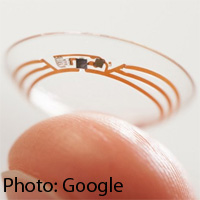 Google has announced plans to build a contact lens that can monitor blood sugar levels. The device that may come replete with miniature, flexible electronics, sensors and antennae. The lens would keep track of blood sugar levels via human tears. Google’s contact lens would be able to alert wearers when their blood sugar levels are too high or too low. For diabetics, this could theoretically free them from the need for frequent finger pricks to check blood sugar. It could also give them tools to better manage their blood sugar. Diabetes can lead to
 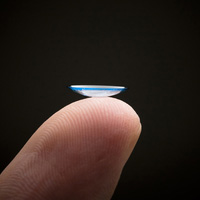 An increase in the use of contact lenses may be making ulcers of the cornea twice as common. A study of over a million Californians showed that people who wore contact lenses were 9 times more likely to suffer from corneal ulcers. Many people do not follow basic contact lens safety principles.
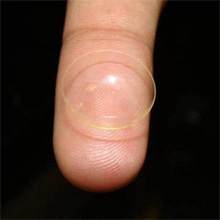 Treatment for the second leading cause of vision loss and blindness, glaucoma, may be improved with a new type of contact lenses that are loaded with Vitamin E. These new Vitamin E contact lenses may serve as delivery devices to treat glaucoma and other eye diseases such as dry eye and cataracts.
 The FDA has issued a Class I recall of certain contact lenses in the AvairaTM line. The lenses may be contaminated with the residue of silicone oil. These contaminated CooperVision contact lenses can cause problems, including severe pain, blurred vision and eye injuries, including torn corneas. Not all users of the contaminated lenses experience symptoms.