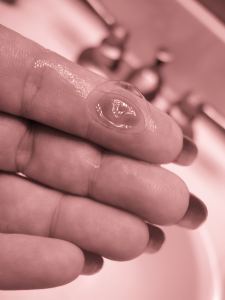
Contact Lenses: Potential Problems With Long-Wearing Silicone Hydrogels

contact lens
image by jdurham

Researchers have found that people who wear silicone hydrogel (SH) contact lenses are likely to suffer corneal staining (mild abrasions of the eye), but that these situations rarely turn into more serious corneal infiltrative events.  Corneal infiltrates are marked by eye discomfort, feeling like there is something in your eye, light sensitivity, and conjunctival hyperemia.

Factors likely to cause these more serious corneal infiltrates include smoking and the presence of bacteria on the lens.  Smoking is a factor in the development of many other eye diseases as well – including everything from dark circles under your eyes to macular degeneration.

Silicone hydrogel lenses are purported to allow more oxygen to the eye and are designed for long term use (up to 3o days in some cases).  SH lenses on the market include:  Ciba Focus Night & Day, Acuvue Oasys, and Bausch and Lomb’s PureVision lenses.

Source: Medscape

Improving Vision In Athletes – And the Rest of Us

pewee baseball
image via santabarbaraca.gov

A survey of Italian coaches, trainers, and physical education teachers sought to determine attitudes toward vision correction in athletes.  Those interviewed believed it was important to correct vision problems during sports, but they were not likely to recommend that their athletes try contact lenses.  Coaches who wore contacts themselves, however, were more likely to suggest them to sports participants.

The researchers, who published their findings in Contact Lens and Anterior Eye, believe that education is key to helping more athletes find solutions to their vision deficits. Source: ScienceDirect

Another solution besides corrective lenses may be the daily practice of eye exercises. (You don’t even have to be an athlete to do them!)

Learn more about how to prevent and treat myopia (nearsightedness) naturally.

Warnings Against Decorative, Non-Prescription Contact Lenses

decorative contact lenses
Image courtesy of fda.gov

It’s October and Halloween is around the corner and that means that many people are going to want to do something to change their appearance.  This year, wear a great mask instead of trying out decorative contact lenses.

The Food and Drug Administration has issued many warnings against buying illegitimate over-the-counter contact lenses.  Even non-corrective lenses are monitored by the FDA out of concerns for public health.  According to the FDA, “Unauthorized contact lenses of all types present risks to the eye that include corneal ulcers, corneal abrasion, vision impairment, and blindness.”

The American Optometric Association has issued its own warnings.  They caution consumers that using  contacts that are not proscribed by a licensed medical professional can lead to “conjunctivitis, swelling, allergic reaction and corneal abrasion due to poor lens fit.”

For information on natural treatment options for conjunctivitis, visit our website.

It is possible to see an eye doctor to determine if you can safely wear cosmetic contact lenses and to get a proper prescription.

Contact Lens Recall Affects Asian & European Markets

contact lenses
image by Celiece

Johnson & Johnson Vision Care has initiated a voluntary recall of its 1-Day Acuvue TruEye contact lenses made of narafilcon A. According the Associated Press, these lenses were only distributed in Japan and parts of Asia and Europe, according to the AP; 100,000 boxes in total have been recalled.  No consumers in either the U.S. or Canada should be effected (the North American lenses are made of narafilcon B).

The recall is bases on a limited number of user complaints related to a stinging sensation felt when the lenses were placed on the eye.  According to Johnson and Johnson  the problem stems from a malfunctioning manufacturing line in Ireland.

This is the eighth recall of a J & J product in the last year including children’s Tylenol and other cold and pain medications.  The company is currently under investigation by the U.S. Congress.

Source: AP https://www.google.com/hostednews/ap/article/ALeqM5gKNufIGxLdxRyZ8TPAzFIe83oA1gD9HPEJA01

Children’s Eye Health: Contact Lenses, Not Glasses May Be Better Option for Kids

kids
Microsoft image

Kids who wear contact lenses rather than glasses enjoy better vision-related quality of life.  A new study published in Optometry and Vision Science reports that in the children who participated in the three year study fared better regarding their feelings about appearance and participation in athletics if they wore contacts.  In particular, children over age 10 experience the greatest improvement in quality of life.

According to Jeffrey J. Walline, O.D, Ph.D., Ohio State University College of Optometry and leader of the Adolescent and Child Health Initiative to Encourage Vision Empowerment (ACHIEVE) Study, “The growing body of research in children’s vision correction continues to demonstrate that contact lenses provide significant benefits to children beyond simply correcting their vision. This study showed considerable improvement for contact lens wearing children 10 years or older in areas of appearance, participation in activities, and satisfaction with vision correction, and it remained or improved over three years.”

Though it is often assumed that glasses are easier to handle than delicate contact lenses, children were happier to work with the contacts than pairs of glasses.  The availability of daily disposable lenses seems to have made the process less troublesome for kids.  It removes the worry over the loss and breakage of eyeglasses.

Researchers “advise parents and eye care practitioners to look beyond the visual benefits” when deciding how to best correct vision problems in children.

This study received partial funding from Johnson and Johnson.

Source: MedicalNewsToday.com

New Contact Lenses Deliver Medication to the Eye

New technology may replace eye drops currently used by people suffering from glaucoma and dry-eye.

Studies have found that a majority of glaucoma patients regularly skip their eye drops, putting themselves at risk for blindness, and that even when drops are used regularly, only a small percentage of the medication tends to be absorbed into the eye.

In an article published in the July issue of Investigative Ophthalmology and Visual Science, scientists announced that they have developed a contact lens that delivers medication to the eye at a constant rate for over 4 weeks. The lenses should not affect the wearer’s vision.

The special lenses were created by dissolving a biodegradable polymer called PLGA in an organic solvent, to which medication was added. After the solvent evaporated, researchers coated the polymer film/medication mix with a hydrogel called pHEMA — the same material used to make regular contact lenses. Researchers believe they can vary the molecular weight of the polymer to change the rate of drug release as needed.

To date the researchers have only tested the diffusion properties of the lens in a lab dish, but expect to be able to test the lenses in humans within a year.

SOURCE: A Drug-Eluting Contact Lens, Ciolino, et al, Investigative Ophthalmology and Visual Science. 2009;50:3346-3352.)

GLA Improves Comfort in Contact Lens-Related Dry Eye

A dry eye study, shows that a group using GLA showed a significant improvement in the specific symptom of “dryness” at 3 and 6 months (p <0.01) as well as significant improvement in overall lens comfort at 6 months (p<0.01). Tear meniscus height was increased in the GLA group at 6 months relative to baseline (p<0.01), although all other objective signs were unchanged

GLA (gamma-linolenic acid) is an omega-6 unsaturated fatty acid made in the human body from linoleic acid, an essential fatty acid found in vegetable oils and egg yolks. GLA has anti-inflammatory properties and can also be found in oils derived from black currant seeds and the evening primrose plant.

Several small trials testing GLA and linoleic (LA) oil in dry eye syndrome with an inflammatory component report reduced ocular surface inflammation and symptom improvement.

Related Studies:
1. Barabino, M et al. Systemic linoleic and gamma-linolenic acid therapy in dry eye syndrome with an inflammatory component. Cornea 22:97–101, 2003.
2. Aragona P, et al. Systemic omega-6 essential fatty acid treatment and PGE1 tear content in Sjogren’s syndrome patients. Invest Ophthalmol Vis Sci 46:4474–9, 2005
3. Kokke KH, et al. Oral omega-6 essential fatty acid treatment in contact lens associated dry eye. Contact Lens Anterior Eye 31:141-6, 2008.
4. Macri A, et al. Effect of linoleic acid and gamma-linolenic acid on tear production, tear clearance and on the ocular surface after photorefractive keratectomy. Graefes Arch Clin Exp Ophthalmol 241: 561-6, 2003.

For more information on dry eyes and natural ways this eye condition can be helped, go to Natural Eye Care
Eye Conditions section and click on Dry Eyes.