Drugs Damage Vision, Sometimes Permanently

There are quite a number of drugs which can harm your eyes – all of the following have the potential to contribute to glaucoma and other vision problems. Just because you can buy something over the counter or with a prescription, doesn’t mean it cannot hurt you.

  • NSAIDs-(non-steroidal anti-inflammatory drugs) include aspirin, ibuprofen (Advil, Motrin, Bayer, Aleve), flurbiprofen, ketoprofen and naproxen sodium. Also Tylenol (acetaminophen), though not an NSAID, can be harmful.
  • Venlafaxine
  • Steroids – cortisone prescriptions such as Prednisone are the most damaging drugs to the eyes of any prescription drugs. If you must take any of these drugs, be sure to supplement your diet with anti-oxidants such as vitamins E and C, and beta-carotene. Ask your doctor if you can replace Prednisone with a natural cortisone such as hydrocortisone.
  • Simvastatin
  • Fenfluramine
  • Amantadine – Patients with the neurodegenerative disease referred to as Parkinson’s are often proscribed the drug amantadine to alleviate motor problems.    Amantadine treatment causes abnormal changes in the cornea in some Parkinson’s patients. Generally, these corneal reactions occur soon after starting the drug and disappear a few weeks after they stop taking. Occasionally, these issues arise after patients have been taking the drug for many years, and, in these cases, patients often do not recover even when amantadine is stopped.A new study has been aimed at discovering  whether the effect of amantadine on corneal endothelial cells is dependent on the cumulative dose received. In a comparison study researchers found that patients with the highest cumulative amantadine intake and/or longest duration of treatment (up to 8 years) had the most significant reductions in endothelial cell density (ECD). Endothelial cells work to keep excess water out of the main body of the cornea. When there are too few endothelial cells, corneal edema (swelling) results and vision is impaired.Study leader, Dr. Won Ryang Wee says: “Assuming other studies confirm these results, ophthalmologists and neurologists should consider evaluating a patient’s corneal endothelium at the beginning of treatment with amantadine and reassess at regular intervals if the drug is used long term, and additional monitoring would be needed for patients with other conditions that reduce ECD–such as recent cataract surgery or ongoing glaucoma, uveitis or Fuch’s dystrophy–because corneal edema could develop during treatment.”Source: https://www.elements4health.com/
  • Mirtazapine
  • Gastric antispasmodics
  • Antidepressants – In the June, 2010 issue of Opthamology Canadian researchers reveal a link between antidepressants known as elective serotonin reuptake inhibitors or SSRIs (including the brand names Luvox, Effexor, Paxil) and cataracts.  Antidepressants are taken by an estimated 10% of the U.S. population.The eye has serotonin receptors in its lens, and animal models have shown that serotonin can increase opacity of the lens and lead to cataracts. This study is the first to demonstrate this phenomenon in humans.
  • Anti-cancer drugs – An article in the journal Eye describes how closed-angle glaucoma (also known as acute glaucoma) can be induced by non-steroidal drugs.  One of the groups of medications named in the study are antineoplastics (anti-cancer medications).
  • Sulfa drugs – According to the article in Eye sulfa drugs can also be related to bilateral glaucoma.  Study authors conclude that these incidences of closed angle glaucoma can be prevented if at-risk patients are identified at the outset and steps are taken to prevent this serious side effect.  Source: Eye, (3 June 2011)
  • Anti-Glaucoma Drugs – The long-term use of topical antiglaucoma drugs can have an effect on the sensitivity of the macula (light-sensitive layer of tissue at the back of the eye).  Authors of this study published in The Annals of Ophthalmology recommend periodic evaluation of the macula for all patients receiving antiglaucomatous agents.  Source: https://www.springerlink.com
  • Sun-sensitizing drugs – A new study published in the Archives of Ophthalmology finds that those who take medications that make them more sensitive to the sun have an increased risk of developing cataracts. And, in case you are thinking that you only have to worry about the sun if you are soaking up the rays on the equator, this study involved residents of Wisconsin who were exposed to their own local sunshine.
  • Party Poppers – A review of cases published in the The New England Journal of Medicine shows that “poppers,” legal recreational drugs common in club culture, can cause light sensitivity and vision loss in some individuals.

In an article by HealthDay Reporter, researchers say, “poppers — a catch-all term for alkyl nitrites that are often inhaled by partyers for a brief ‘head rush’ and to increase sexual arousal — may compromise the normal workings of photoreceptor cells found in a key region of the eye’s retina.”  They go on to explain that “nitric oxide is known to affect the metabolism of photoreceptors and can also alter the operation of a key enzyme involved in photoreceptor function.” Researchers did note that those who stopped taking poppers seemed to recover over a period of several months.  Experts do not yet agree fully on the correlation between the use of this drug and the damage to the eyes; some believe evidence is simply anecdotal at this stage and that more formal research is necessary. Source: https://www.medicinenet.com

A much safer course than automatically taking a lot of drugs, ie, for a headache, is to look at other contributing factors and make lifestyle changes in the amount of rest you get, the amount of exercise you get, your diet, levels of stress in your life, and so forth.

What are the conventional treatment options for glaucoma? Do they work?

Treatment depends on the nature and severity of each case. Commonly, open angle glaucoma is treated with eyedrops or oral medications. In the event this treatment does not lower the eye pressure inside the eye, laser therapy or surgery may be necessary. There are no guarantees!

What about alternative treatment?

Since we consider most eye conditions to be a reflection of the health of the whole body, lifestyle choices and diet can play a major factor in getting and maintaining good vision. Below are some recommendations:

  • Studies show patients can reduce their eye pressure by five to seven millimeters with an improved diet and supplement program. In general, a diet high in betacarotene, vitamins C and E, and sulfur-bearing amino acids are recommended. Foods containing those nutrients include garlic, onions, beans, spinach, celery, turnips, yellow and orange vegetables, green leafy vegetables, seaweed, apples, oranges and tomatoes.
  • The Vision Diet – recommended in Natural Eye Care: Your Guide to Healthy Vision and Healing, authored by Marc Grossman, O.D., L.Ac. and Michael Edson, MS, L.Ac. This CD covers nore than 40 major eye conditions including glaucoma with specific nutrient, diet, exercise and juicing instructions by eye condition, plus much more.
  • Daily juicing of vegetables and fruits (preferably organic). Our glaucoma recipe is some combination of the following: celery, carrots, cucumber, radish, turnip, parsley, beets, cabbage, raspberries, plums, apple (not too much fruit). For more information, go to info about juicing.
  • Drink lots of water – 8-10 glasses of purified water. Avoid carbonated, caffeinated and alcoholic beverages. They can actually dehydrate your eyes.
  • Manage your stress – meditate, take a walk in nature, practice yoga, visualization techniques or prayer on a daily basis.
  • Exercise daily – do at least 20 minutes of aerobic exercise daily. Walking and swimming are two excellent forms of exercise.
  • Eye exercises can help to bring energy and blood to the eyes, thereby helping to drain away toxins or congestion to the eyes. These are free general eye exercises and acupressure points for overall eye health. See Free Eye Exercises
  • Avoid foods to which you are allergic: a study of 113 patients with chronic simple glaucoma showed immediate IOP increases of up to 20 millimeters when they were exposed to foods in to which they were allergic.
  • Supplement your diet with a specific eye formula such as the Optic Nerve Formula and an organic green drink daily.


Juicing Tips – What combinations of fruits & vegetables would be best to juice?

Overview | Enzymes | Recipes

Juicing Tips

We consider daily juicing of primarily organic vegetables and fruits to be an essential part of any long term healing program. Juicing provides a highly effective and efficient way for the body to be able to absorb essential nutrients into the blood and cells, taking a little as a few minutes for the body to start utilizing these nutrients.

Why is juicing so important?

    1. What are enzymes? The basic key to the efficacy of nourishing your body is the life present in food and of those intangible elements known as enzymes.  
    2. Why not just eat fruits and vegetables for our essential nutrients? Solid food requires many hours of digestive activity before its nourishment is finally available to the cells and tissues of the body. 
    3. Can juicing prevent disease? Many studies point out that a diet high in fruits and vegetables does in fact reduce the incidents of serious disease.
    4. Do vegetables contain protein? Although fruits and vegetables do not contain large quantities of protein, their juice can be a convenient carrier.
    5. What are phytochemicals? They are substances in plants that are linked to good health and to prevention of specific diseases. They are found only in fruits and vegetables, and juicing is a great way to get them.
    6. How much juice can be taken safely? As much as one can drink comfortably without forcing oneself. Recommended amount of juice per day is at least 1 pint per day. Some healing centers actually do 2-8 pints per day for therapeutic purposes.
    7. Can I store the juice I make? Juices should generally be drunk when prepared, since certain enzymes and vitamins break down pretty quickly in sunlight.
    8. What combinations of fruits and vegetables would be best to juice? There are many different recipes  See more info …, but in general at least 50-75% of the juicing should consist of greens (spinach, kale, chard, parsley, dandelion, watercress, broccoli, etc.)
    9. Can I still continue to eat fast food and sugar products? These should be kept to an absolute minimum as they use our precious resources to breakdown and digest, offering little in the way of healthy nutrients.
    10. Should I use only organic products? In general, yes. By juicing all non-organic products, we stand the chance of taking in concentrated amounts of pesticides used on the plants, thereby negating the value of daily juicing.
    11. What juicer should I use? There are a number of excellent juicers.  We like the pulp extracting omega juicers that juice without generating heat that can destroy some of the essential nutrients. At 80 RPM (most juicers work at 3600 RPM and higher), it essentially masticates the fruits and vegetables slowly, preserving the most nutrients possible. The disadvantage is that the process is a little slower, and cleaning takes a couple of more minutes.

What are enzymes?

The basic key to the efficacy of nourishing your body is the life present in food and of those intangible elements known as enzymes. Enzymes are complex substances that enable us to digest food and absorb it into our blood. They are the body’s ‘working force’ that act as catalysts for many essential life functions, such as separating the nitrogen from the air we breath, so we may absorb the oxygen. They act as catalysts in probably millions of chemical reactions that take place throughout the body. They are essential for the digestion and absorption of the food we eat and drink … for conversion of food to body tissue, and for the production of energy at the cellular level.

Enzymes become sluggish at cooking temperatures above 118 degrees, and are destroyed at temperatures above 130 degrees (microwaves completely destroy enzymes in your food).
Fresh juices are a wonderful source of enzymes. Food which has been cooked at temperatures above 118 simply don’t have the properly functioning enzymes to allow you to enjoy the full benefits of their nutrients.

Why not just eat fruits and vegetables for our essential nutrients?

Solid food requires many hours of digestive activity before its nourishment is finally available to the cells and tissues of the body. While fibers in foods are essential for helping cleanse our digestive tract, the removal of fibers in the extraction of juices allows essential nutrients to be absorbed within minutes instead of hours, and with little effort by our body.

Do vegetables contain protein?

Although fruits and vegetables do not contain large quantities of protein, their juice can be a convenient carrier. Simply add some brewer’s yeast, wheat germ, or whole grains to whatever you’re juicing. These give you protein without the fat that meat contains, and protein that is quickly and easily absorbed by the body.

What to Juice?

There are many different recipes but in general at least 50-75% of the juicing should consist of greens: spinach, kale, chard, parsley, dandelion, watercress, broccoli, etc.

Sample Juicing Recipes for Specific Eye Conditions

Cataracts, Conjunctivitis
We recommend carrot, spinach, celery, endive, parsley, blueberry, apple – not too much fruit.

Glaucoma
We recommend celery, carrots, cucumber, radish, turnip, parsley, beets, cabbage, raspberries, plums, apple (not too much fruit).

Macular Degeneration
We recommend broccoli, green bell pepper, red bell pepper, apples, raspberries, leafy greens

Best’s Disease

We recommend daily juicing of vegetables and fruits (preferably organic) – some combination of the following: ginger, garlic, leeks, parsley, beets, cabbage, carrots, celery, spinach, apples, grapes, raspberries, lemon, chlorophyll, wheat grasses (not too much fruit). See the discussion of best’s disease for other points

Optic Neuritis

We recommend: ginger, parsley, beets, cabbage, carrots, endive, chlorophyll, wheat grasses, berries (all organic preferably)

Other Conditions

Peptic Ulcers – cabbage juice promotes rapid healing of patients with peptic ulcers

Urinary Tract Infections – cranberry juice is well known to help with bladder and urinary tract infections

Heart Disease – also well known is the beneficial effect of pomegranate juice. Antioxidants (compounds that limit cell damage by fighting free radicals) contained in pomegranate juice may help reduce the formation of fatty deposits on artery walls. The antioxidant level in pomegranate juice was found to be higher than that in other natural juices, such as blueberry, cranberry, and orange juices.

Resources
N.W. Walker, D.Sc. “Fresh Vegetable and Fruit Juices: what’s missing in your body?”
Michael T. Murray, N.D. “The Complete Book of Juicing”

Paul Pitchford, N.D. “Healing with Whole Foods”

Research on peptic ulcers & cabbage juice
Research on UTI & cranberry juice

Diet and supplements may be helpful for floaters

Most floaters are the result of bits of cells that remain in the vitreous humor after birth and float around when the vitreous becomes more liquified later in life.

Over 50% of people over 70 years of age report seeing floaters. Most floaters are age-related. The vitreous humor thickens and clumps as we age, and floaters result from the clumped vitreous gel.

From a Chinese Medicine perspective, floaters are an indication of congestion in the liver, kidney and colon. Nutrients can eliminate congestion in these organs in order to keep the vitreous of the eye clear from these annoying specks, as well as to help strengthen the retinal tissue and integrity of the blood vessels.

Read more about why eye floaters develop and what you can do about them, as well as other causes of spots and dots in the eyes along with some cautions. Specific nutrients recommended are the chinese herbal classic formula Rambling Powder (Xiao Yao San) and Advanced Eye & Vision Support Formula, a proprietary formula of European Bilberry (Vaccinium myrtillus), South American Blueberry (Vaccinium spp.), European Eyebright Herb (Euphrasia off.), European Horsetail Herb (Equisetum arv.), European Pine Bark (Pinus pinaster), South American Barberry Bark (Berberis vulgaris), Chinese Gingko Biloba Leaf, Lutein (3.5mg), Zeaxanthin (6mg) from Marigold (Tagetes erecta), Alpha Lipoic Acid (naturally-derived), Grape Seed Extract (pesticide-free), South American Piper Nigrum Seed, Grade A Japanese Chlorella (C. pyrenoidosa), Wild Blue Green Algae (Aphan. flos-aquae), European Vegetable Extracts (Carrot, Broccoli), European Propolis Extract(pesticide-free), Medicinal Mushroom Extracts (raw & fermented mycelial extracts), Reishi (Hericium erin.), Coriolus versicolor; Japanese Marine Coral Minerals, Stabilized Rice Bran, and Plant Enzymes.

Macular Degeneration Vision Improved with Implantable Telescopes

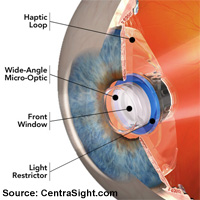
centrasight implantable telescope AMDCentraSight Implantable Telescope

The CentraSightTM treatment program has introduced a tiny implantable telescope  to improve central vision loss caused by ARMD. Though there is no cure for AMD at this time, nine out of ten patients in a clinical trial reported visual improvement and quality of life.

ARMD is the leading cause of vision Continue reading “Macular Degeneration Vision Improved with Implantable Telescopes”