Caffeine in Coffee May Offer Antioxidant Benefits

The antioxidants found in beverages and foods that contain caffeine seem to protect people against the development of Alzheimer’s disease and heart disease.

In a study published in The Journal of Physical Chemistry B researchers describe how coffee can be on the greatest sources of antioxidants in the modern diet.  Scientists do not know exactly how coffee helps to fight the free radicals that can be destructive to eye health and overall health.  At this point, they are speculating that caffeine is the agent responsible for coffee antioxidant properties.

These findings are actually in direct opposition to our usual recommendations for people who suffer from eye conditions related to the presence of free radicals including macular degeneration and glaucoma.  More research is necessary to determine whether the benefits of caffeine outweigh its negative effects.

Source: sciencedaily.com

But, Too Much Coffee …

Five or more cups of coffee per day may cause an individual to hallucinate.

A study out of Australia’s La Trobe University looked at the roles that caffeine and stress play on instances of auditory hallucinations.  Participants who were under stress and under the effect of high levels of caffeine listened to white noise and were asked to indicate when they heard Bing Crosby sing “White Christmas.”  Those reporting highest stress and caffeine levels were much more likely to report hearing the song (which was never played) than were those with low stress and caffeine levels.

‘It is apparent that the health risks of excessive caffeine use must be addressed and caution should be raised with regards to the exacerbating use of this stimulant,’ says Professor Simon Crowe.

We caution clients and patients against consuming coffee and other sources of caffeine if they are concerned about eye conditions including diabetic retinopathy, glaucoma, and dry eyes.
Antioxidants Help Glaucoma Patients

Glaucoma’s progress can be slowed as the result of taking the antioxidants vitamin E and N-acetyl cysteine.

A study published in Investigative Ophthalmology and Visual Science describes how reducing or reversing oxidation within the eyes may lead to the healing of the trabecular meshwork or outflow pathway in glaucoma patients.  As the name suggests, antioxidants (like vitamin C and N-acetyl cysteine, which is found in eggs) combat the natural process of oxidization.

According to the study, the free radicals that result from the oxidation process lead to the destruction of the trabecular meshwork, which can lead to increased ocular pressure and glaucoma.  (Issue: 49:1447-58, 2008)

Neuroprotective Agents

Medscape Today’s 2010 article addresses  slowing or halting the development of glaucoma by shielding undamaged nerve cells and restoring or rescuing nerve cells that have already been damaged.  In addition to describing more traditional pharmaceutical options for fighting glaucoma, the review includes a discussion of several antioxidants including melatonin, Coenzyme Q10, vitamin E, and ginkgo biloba.  Antioxidants, a more natural approach than the pharmaceuticals in the study, may be helpful neuroprotective agents.

Neuroprotective: Melatonin

According to an article published in The Journal of Pineal Research, evidence from a number of sources supports the assertion that increased free radical generation and altered nitric oxide (NO) metabolism contribute to glaucoma and uveitis. Data indicates that melatonin is an efficient antioxidant that has the ability to fight free radicals and break down nitric oxide and plays ” a promising role in the treatment of these ocular dysfunctions.”  Melatonin has few side effects even at high doses and can potentially do a great deal to protect ocular tissue.

Source: interscience.wiley.com/

Glaucoma in Black Women & Antioxidants

At the American Glaucoma Society meeting, Dr. JoAnn A. Giaconi reported that women who reported eating greater amounts of fruits and vegetables appeared to have a lower likelihood of developing glaucoma.

The foods that seemed especially protective included fresh oranges, peaches, spinach, collard greens, and kale.

Dr. Giaconi presented results from a review of data from the Study of Osteoporotic Fractures.  In this study involving a subset of 584 black women, glaucoma was diagnosed in at least one eye in 77 participants.  Disc photos and supra-threshold visual fields were evaluated in conjunction with Block Food Frequency Questionnaires on the participants’ daily food consumption.

The results?

  • Eating three or more servings of fruit or fruit juices daily decreased the odds of black women developing glaucoma by 79%
  • Eating one serving of collard greens or kale decreased the odds of glaucoma by 57%
  • Eating more than two servings per week of fresh oranges and peaches also significantly decreased the chance of developing glaucoma.

Researchers believe that the antioxidants in fruits and vegetables (vitamin A, alpha- and beta-carotene, folate, lutein, zeaxanthin) can potentially block oxidation stress that can lead to cell damage in glaucoma.

SOURCE:  Giaconi JA, et al. Nutritional associations with glaucoma among older black women. Paper presented at: The 18th Annual AGS Meeting; March 8, 2008; Washington, DC.

Fruits and Vegetables

Researchers at the Department of Ophthalmology and Jules Stein Eye Institute, University of California-Los Angeles, recently studied the association between consumption of fruits and vegetables and the presence of glaucoma.

1,155 women located in multiple centers in the United States participated in this cross-sectional cohort study. Glaucoma specialists evaluated the women for glaucoma; consumption of fruits and vegetables was assessed using a food frequency questionnaire.

Among the 1,155 women studied, 95 (8.2%) were diagnosed with glaucoma. Analysis of the relationship between selected fruit and vegetable consumption and glaucoma showed:

  • Glaucoma risk was decreased 69 percent in women who consumed at least one serving per month of green collards and kale compared with those who consumed fewer than one serving per month.
  •  Glaucoma risk was decreased 64 percent in women who consumed more than two servings per week of carrots compared with those who consumed fewer than one serving per week.
  • Glaucoma risk was decreased 47 percent in women who consumed at least one serving per week of canned or dried peaches compared with those who consumed fewer than one serving per month.

Although researchers note that more studies are needed to investigate the relationship between nutrition and glaucoma, research to date does indicate that a higher intake of certain fruits and vegetables may be associated with a decreased risk of glaucoma.

SOURCE: “Glaucoma risk and the consumption of fruits and vegetables among older women in the study of osteoporotic fractures”, Coleman, et al, Am J Ophthalmol. 2008 Jun;145(6):1081-9.


Garlic, Ginger, Turmeric All Help Regulate Diabetes

Diabetes & Spices
Image via doh.sd.gov

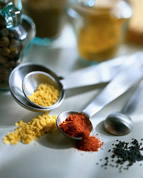
Another major study describes how some of the spices in your kitchen can help treat diabetes.

Garlic, ginger, and turmeric were found to have positive effects on diabetic rats.  The study, published in the British Journal of Nutrition (2011), 105: 1210-1217, finds that ingesting these common spices helped the animals who suffered from metabolic syndrome and helped modulate oxidative stress levels.

Rats who took the spices in powder form mixed with water for 28 days showed a 80-97% reduction in metabolic syndrome symptoms.  The animals’ insulin production increased by 26-37% and their antioxidant defense systems were boosted by up to 52%.

Of the three spices tested, garlic seemed to have the most profound impact on reducing the risks associated with metabolic syndrome and related cardiovascular problems.

Source: https://journals.cambridge.org

Important Note: Before taking turmeric supplements check with your doctor if you are taking a blood thinner.  While adding a bit of turmeric to your cooking is usually ok, more concentrated forms have a lot of punch.  Curcumin, the active ingredient of turmeric is a blood thinner.

Eat Right With Color: Blue Foods Are Great Eye Foods

March is the American Dietetic Association’s National Nutrition Month.

This year, the theme is “Eat Right with Color.”  That seems particularly fitting since seeing color is one of the things we value most about our eyes.  The colors of the foods we eat – we are specifically talking about fruits and vegetables here – are often indicative of the nutrients they will deliver.

Check out the ADA’s guide for what colors indicate what great health benefits.

What’s an optometrist’s favorite color?  Blue.

Bilberry (a cousin of the blueberry) is the ultimate eye food, mainly because it contains carotenoids, which are powerful antioxidants.  Getting your does of blue foods will help anyone concerned about Poor Night Vision, Glaucoma, Myopia, Macular Degeneration, Diabetic Retinopathy, Cataracts, or Computer Eye Syndrome.

Learn about how to prevent and treat diabetes naturally at our website.

Also, get the facts about the related condition, diabetic retinopathy.

Free Radicals May Help the Heart (But Don’t Toss Your Antioxidants!)

Free Radicals - Heart HealthFree radicals might be a good thing?

At Natural Eye Care, we extol the benefits of antioxidants because they fight the free radicals that lead to oxidation, which in turn cause aging: skin changes such as the appearance wrinkles, and ocular changes, including the development of cataracts and macular degeneration.

Your eyes love antioxidants like those found in bilberry (a close relative to the blueberry) and in high quality supplements.

And yet, a new study published in The Journal of Physiology (online 28 February 2011) describes how free radicals are actually essential to the healthy functioning of the heart.

It is true that high levels of free radicals can lead to heart disease, but the heart does need some quantities of free radicals to help it deal with stressful situations.

As described at Medical News Today, when under stress, the nervous system produces what are called beta-adrenergic receptors.  These beta-adrenergic receptors actually produce free radicals not as a negative byproduct of metabolism (as we usually describe the process), but to make the muscles of the heart contract more strongly when necessary.  The heart is then able to pump more blood throughout the body to nourish and sustain us in stressful situations.

This is not to say that you should toss out your antioxidants, but it does remind us that the body is an amazing and complex creation that rarely allows us to use a one-size-fits-all approach to disease or nutrition.


Alzheimer’s Disease Onset Delayed In Bilingual People


Closeup portrait of a smiling elderly woman

Parlez-vous Français?

A new study in the journal Neurology indicates that speaking a second language can help fend off the development of neurological diseases like Alzheimer’s.

Research indicates that those who speak a foreign language are likely to be diagnosed with Alzheimer’s four years later than those who only speak one language.  Brain scans indicated that bilingual people demonstrate superior cognitive function even when they have more advanced brain deterioration when compared to their single language speaking counterparts.  Previous studies have established that speech and language issues are linked to dementia.  Source: https://www.foodconsumer.org/newsite/Non-food/Disease/language_delays_onset_of_dementia_0219110210.html


Certain supplements have been reported to aid in the prevention of Alzheimer’s including acetyl-L-carnitine, antioxidants, and B vitamins.  For an extensive discussion of complementary treatment for Alzheimer’s disease, please visit our website.


Fuchs Corneal Dystrophy Linked to Oxidative Stress


Fuchs dystrophy is a slowly progressing disease that occurs when endothelial cells gradually deteriorate without any apparent reason.  Eventually, it causes the cornea to swell and makes vision distorted.

A study published in The American Journal of Pathology indicates that oxidative stress plays a part in the onset of Fuchs corneal dystrophy.  People affected with the disease showed much higher levels of oxidative DNA damage in their eyes that the control group that did not have the disease.  Source: Elsvierhealth.com

Antioxidants are well known to play a vital role in eye health.  Extensive studies have shown that taking antioxidants in the form of food and nutritional supplements can help prevent and even reverse such eye conditions as macular degeneration, and cataracts.

Learn more about how to treat Fuch’s dystrophy naturally.

Heart Health Depends on Fruit and Vegetable Consumption: New Study

There’s even more science to back up the claim that eating fruits and vegetables will help you fight heart disease.

The European Prospective Investigation into Cancer and Nutrition has published a paper on heart health.  Researchers indicate that those who eat at least 8 servings of fruits and vegetables each day are 22% less likely to die of heart disease.  A “serving” is equal to a small banana, a medium apple, or a small carrot.

One theory is that the antioxidant micronutrients in fruits and veggies reduce the oxidative damage that causes hardening of the arteries or atherosclerosis. At the same time, it is important not just to take antioxidant supplements but to eat the whole food as other compounds in fruits and vegetables also may protect the heart.

Source: TheHeart.org

Learn more about the nutrients available in whole food sources.

Also learn about other ways, besides diet, that you can keep your heart health and avoid atherosclerosis.

Alzheimer’s Disease May Respond To Compounds in Green Tea

green tea
image via www.epa.gov

New studies are finding that Alzheimer’s Disease may be the result of the build up of β-amyloid peptides (Aβ) in the brain and green tea might be a good candidate for the clean up crew.  A green tea extract that was particularly bioavailable (the body was capable of absorbing its “good stuff”) was found to be capable of lower brain toxicity levels.  Source: Nutraceuticals World

Green tea can be a powerful source of antioxidants.  Other studies have found that people who take antioxidant supplements (vitamin C or vitamin E) have a lower risk of Alzheimer’s disease compared with people who do not take antioxidants. Preliminary research shows that higher blood levels of vitamin E correlate with better brain functioning in middle-aged and older adults.

Learn more about how nutrition and supplements can help ward off Alzheimer’s Disease.


Blueberries Can Improve Memory and Prevent Eye Disease

A new study of lab rats recently published in the journal Nutrition shows that blueberries can increase memory.

One month of a blueberry rich diet made older rats perform as well as young rats on memory tests and the benefits lasted even after they stopped eating the blueberry diet.

Researchers credit the power of antioxidants with this increase brain performance.
Source: nutraingredients

We also know that antioxidants in blueberries and their cousins the bilberry can help improve and maintain eye health.  Antioxidants can help prevent and treat macular degeneration and cataracts.