
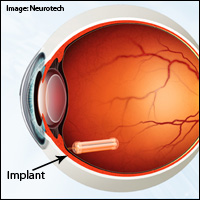
 Clinical trials are underway for an implantable device that delivers medication directly to the eyes of people with age-related macular degeneration. Current treatment involves eye injections every four-to-eight weeks, which is difficult to comply with and can create complications. The new technology is a tiny device that is put into the eye and lasts up to 2 years, reducing or eliminating the need for the injections. The devices are being developed by Cumberland, Rhode Island-based Neurotech. Continue reading “Avoid Eye Injections for Macular Degeneration with Encapsulated Cell Therapy (ECT)”
Category: Retinitis Pigmentosa
Rod Opsin Human Protein May Restore Vision for Retinitis Pigmentosa Patients
 Experiments on mice show promise for a treatment that expresses a light-sensitive human protein, called rod opsin, on the undamaged retinal cells. These cells are turned into photoreceptors, which allow vision.
Retinitis pigmentosa is a group of eye disorders that appear to be genetic. This eye disease is a major cause of vision loss and blindness. Continue reading “Rod Opsin Human Protein May Restore Vision for Retinitis Pigmentosa Patients”
Bone Marrow Stem Cells May Treat AMD, Stargardt’s & Retinitis Pigmentosa
 Future treatments for macular degeneration (AMD), Stargardt’s disease, and retinitis pigmentosa may include bone marrow stem cell injections, if a new line of eye research pans out. A preliminary pilot study on six subjects with one of several ischemic eye diseases found that most patients had vision improvement after receiving injections of their own bone marrow.
The purpose of the study was to find out if there were any adverse side effects and to test for vision improvement. The only significant negative side effect was some pain after bone marrow Continue reading “Bone Marrow Stem Cells May Treat AMD, Stargardt’s & Retinitis Pigmentosa”
Optogenetics Reverse the Decay of Retina Cells to Restore Sight
 Scientists have partially restored sight in blind mice using a protein to repair damaged cells in the retina. These experiments may ultimately lead to treatments that restore sight in patients with progressive degenerative retinal diseases such as diabetic retinopathy, retinitis pigmentosa and macular degeneration.
The research at the University of Bern in Switzerland and the University of Göttingen in Germany used “optogenetics,” which involves utilizing light to control neurons. They introduced new light-sensing proteins called Opto-mGluR6 into the eye. In essence, this turned the old cells into photoreceptors. These cells were then able to process Continue reading “Optogenetics Reverse the Decay of Retina Cells to Restore Sight”
Natural Eye Care’s Retinitis Pigmentosa (RP) Complete Overview
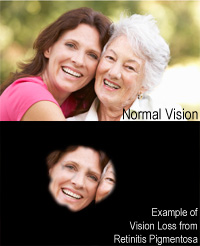 Retinitis pigmentosa (RP) is an eye disease that can cause serious vision loss, and it is usually inherited. Its symptoms can begin at any age and include reduced peripheral vision (tunnel vision), night blindness, difficulty adapting to changes in light levels, and eventually, blindness. RP is a type of retinal dystrophy that results in progressive degeneration of rod photoreceptor cells. While this disease is degenerative, much can be done to reduce or delay its effects.
How Retinitis Pigmentosa Is Diagnosed
Any changes in vision should be reported to an eye doctor immediately. Initially, RP patients may notice gradual changes in peripheral vision — the vision to the sides, top and bottom of the field of vision. Any symptoms Continue reading “Natural Eye Care’s Retinitis Pigmentosa (RP) Complete Overview”
RST-001 Can Treat Retinitis Pigmentosa (RP)
RetroSense Therapeutics has received Orphan Drug designation from the Food and Drug Administration (FDA) for its lead product, RST-001, to treat retinitis pigmentosa (RP).
 RP is a rare eye disease in which light receptors in the eye gradually die off, eventually leading to blindness. RP can be due to any one of over a hundred different gene defects. Currently there is no conventional treatment or cure, but nutritional therapies have been shown to slow the progress of the retinitis pigmentosa.
However, RetroSense is employing Continue reading “RST-001 Can Treat Retinitis Pigmentosa (RP)”
Iodine Supplement May Help Retinitis Pigmentosa Swelling – Cystoid Macular Edema (CME)
 Research suggests that individuals with retinitis pigmentosa (RP) may benefit from a dietary iodine supplement. RP patients often experience retinal swelling as a result of Cystoid Macular Edema (CME). A study published in JAMA Ophthalmology showed swelling due to CME to be inversely related to iodine intake.
The study was conducted by researchers from Massachusetts Eye and Ear, Harvard Medical School, and Boston University School of Medicine. Using a Continue reading “Iodine Supplement May Help Retinitis Pigmentosa Swelling – Cystoid Macular Edema (CME)”
Notable People Who Have Vision Conditions
Even VIPs have eye conditions. Here’s an interesting collection of ten notables who have serious vision conditions, and who have made a success of their lives nonetheless!
 1. Steve Wynn: Las Vegas casino developer and the owner of such resorts as the Wynn Las Vegas, Wynn Macau, Bellagio, The Mirage, et cetera. Wynn has developed retinitis pigmentosa which includes progressive degeneration of the photoreceptor cells of the retina. Such degeneration results in poor night vision, light to dark adaption and impaired peripheral vision. Mr. Wynn recently partnered with the University of Iowa to establish the Stephen A. Wynn Institute for Vision Research. He donated $25 million to help the university find a cure for blinding eye diseases.
2. Jon Wellner: American actor with the recurring role as toxicologist Henry Andrews in CSI: Crime Scene Investigation. Wellner also has retinitis pigmentosa which has not yet impacted his work. He does however wear glasses. Not only does he continue to act but he also owns his own research company that does research for CSI: Miami, Bones, CSI: Crime Scene Investigation, and others. Continue reading “Notable People Who Have Vision Conditions”
Usher Syndrome and the Eyes
 Usher Syndrome is a genetic condition that leads to loss of hearing, balance and vision. It is the most common cause of deaf-blindness and accounts for 2-6% of the deaf population. The vision loss from Usher Syndrome is retinitis pigmentosa (degenerating retinal cells).
This condition was described in 1914 by Charles Usher, an English eye doctor. It is autosomal recessive, meaning both parents must carry the gene for the condition to Continue reading “Usher Syndrome and the Eyes”
Stem Cells Discovered in Fat May Treat Macular Degeneration, Retinitis Pigmentosa, Stargardt’s
 The potential is great for these stem cells to aid in healing damaged and diseased tissues. Not to mention most adults wouldn’t mind giving up a little extra fat for something that could save lives.
Stem cells are valued tremendously for their ability to transform into any type of tissue. The capability of the cells to grow into anything from bone to nerve to heart translates to the conceivable treatment of countless diseases. Previous research has largely been Continue reading “Stem Cells Discovered in Fat May Treat Macular Degeneration, Retinitis Pigmentosa, Stargardt’s”