
Eye Contact Avoided by Bipolar Children

eye contactA recent study showed that bipolar children spend less time making eye contact with people – looking at their eyes – versus typical children. Instead of looking at the eyes, bipolar children and children with severe mood dysregulation in the study spent less time looking at the eyes when observing faces. Instead, they spent more time with their eyes on the mouth and nose.

U.S. National Institute of Mental Health investigators suggested the eye contact habits of bipolar children as a possible explanation why these children have trouble determining  how other people feel.

This study has not yet been published in a peer-reviewed journal, so it should be considered preliminary. If accepted by the psychiatric community, this eye contact research may help develop treatment plans that education bipolar children guess the emotional state of people by looking more often at the eyes. In turn, they may process emotional information more accurately, which could help them regulate their feelings when interacting with others.

Continue reading “Eye Contact Avoided by Bipolar Children”

Outdoor Activity Might Reduce Myopia in Children

outdoor time may reduce myopia in children and teensThe rise of myopia, also known as shortsightedness, has increased significantly in the past 30 years in the United States. Time spent outdoors has dropped off in this time period. Researchers at the National Eye Institute conducted a study of children and teens that shows a possible link between less time spent in outdoor activity and myopia.
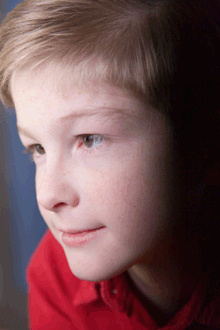


In the early 1970’s, 25% of 12 to 54 year olds in the United States had myopia. In 1999-2004, that figure was 42%, a huge increase.

Myopia means that the eye focuses in front of the retina, making vision blurry. This condition is thought to be caused by Continue reading “Outdoor Activity Might Reduce Myopia in Children”

New Device Makes “Lazy Eye” Test for Children Easier

Lazy Eye Test
Image via NIH.gov

Amblyopia, or lazy eye, is a condition that affects 3-5% of children.  Early detection is key, and a new test developed by doctors at Children’s Hospital Boston looks to determine whether kids as young as 2 years old have the condition in just a few seconds.  Amblyopia is potentially blinding because the brain will actually lose the ability to process visual information from the weaker eye.  It is important that toddlers and preschoolers get tested because it is often too late to fully correct the problem in school aged children.

This new device called the Pediatric Vision Scanner appears in a July 7 article in Investigative Ophthalmology and Visual Science.  The tool uses laser technology to measure the eyes’ alignment.  Source: Medical News Today, July 9, 2011

Learn more about binocular conditions that affect the eyes’ ability to effectively work together.

Uveitis Is More Severe In Youngest Patients, Adult Risks

Uveitis in Children

image via CDC.gov

Uveitis means “inflammation of the uvea,” an inner layer of the eye, that can result in severe and permanent vision loss. In addition, uveitis can lead to other ocular complications including glaucoma, cataracts, or retinal damage all of which can severely damage the eyes. Early detection and treatment is necessary to reduce the risk of permanent vision loss.

A study published in the British Journal of Ophthalmology examines cases of the condition in children.  The study found that the younger a child is when he develops the disease, the more likely he is to have complications.  Complications include the development of secondary glaucoma, cataracts, and vitreous hemorrhage.  Children who developed uveitis when they were younger were also less likely to experience remission.  Researchers recommend that kids who show signs of uveitis at a young age (perhaps before age 7) receive more intensive monitoring.  Source: British Journal of Ophthalmology (2011;95:646-651)

Adult Uveitis

As part of our Vision Wellness Protocol to prevent all eye diseases, we always recommend that you stop smoking.  Here’s another reason to quit: people who smoke are more than two times as likely to develop uveitis than non-smokers.

Uveitis can be a result of trauma to the eye, but often it is not possible to trace its cause.  But, as this study suggests, we may be able to add smoking to the list.  According to study author Nisha Acharya, MD, “Cigarette smoke includes compounds that stimulate inflammation within the blood vessels, and this may contribute to immune system disruption and uveitis.”

Source https://www.sciencedaily.com

Steroid Treatment for Uveitis: Problems

A recent study of patients undergoing long term topical steroid treatment (e.g. eyedrops) shows that the medication increases the likelihood of developing sub-conjunctival hemorrhage.

The study, published in the medical journal Eye found that those taking steroid eyedrops for uveitis (inflammation of the middle layer of the eye) ran a “substantial” risk of developing spontaneous hemorrhaging in the eyes.  Source: https://www.nature.com/

For more on uveitis, including how to prevent and treat it naturally, visit our website.


Visual Impairment Can Negatively Impact Kids’ Quality of Life

Researchers ask so many questions about obscure topics, sometimes it is surprising when some topics are studied for the first time.

A study published in the British Journal of Ophthalmology claims to be first to have studied how visual impairment impacts the quality of life in children between the ages of 3 and 16.  A trial including 24 children who had impaired vision and 24 who had normal vision, showed that the kids with sight deficiencies scored almost 36% lower on quality of life questionnaires.  Researchers indicated that better accommodations need to be made for children with visual disabilities.  Source:British Journal of Ophthalmology

Binocular conditions, which generally refer to problems that make it difficult for the eyes to work together, can often affect kids’ ability to read, concentrate, an enjoy sports activities.

DHA For Infant Eye Health

Do omega-3’s help infant eye development?  The European Parliament is going to vote on whether manufacturers are allowed to claim that DHA helps babies’ eyes.

The issue of how and what to feed babies is always controversial, especially when one wades into the breast milk versus formula debate.  In this case, the question is whether infant formula should be supplemented with DHA.

The March of Dimes does recommend that pregnant women get enough DHA to enable health brain and eye development.  They say, “After the baby is born, DHA consumed through breastfeeding may also help the baby’s eyes and vision… Breast milk is the preferred way for infants to consume adequate amounts of DHA and ARA. If the mother decides not to breast feed, then the infant should be fed only supplemented formulas which contain DHA and ARA. Adequate DHA levels may lead to improved developmental outcomes, including improved mental, visual and motor skill development.”  Source: March of Dimes

Cataracts and Glaucoma in Children Linked to Genetic Defect

Cataracts & GlaucomaA genetic glitch may be responsible for incidents of cataracts in children.

According to a press release from Maine’s Jackson Laboratory, researchers have found that RNA granules, which are key components in the reproduction of genes, might be linked to eye development.  Problems with RNA granules can result in juvenile cataracts and glaucoma.  If there is a problem with a key gene, Tdrd7, the development of the lens of the eye will be compromised, leading to these potentially blinding conditions.

The study was conducted with mice, but scientists believe that when children are missing the essential protein created by this specific gene they will be born with cataracts.  Furthermore, the genetic mutation will mean that even after the surgical removal of cataracts, the affected children will be likely to develop glaucoma because they  “may not have adequate protection from oxidative stress in the drainage structures of the eye.”

These finding will be published in the journal Science.

Source: The Jackson Laboratory

Update: Corneal Thickness Gene

One risk factor for glaucoma is central corneal thickness.

Researchers looking at ethnic populations in Singapore have identified the genes that affect collagen growth, which in turn affects central corneal thickness.  Knowing how these specific genes work can help provide insight into the cause and progression of glaucoma.

Source: hmg.oxfordjournals.org/

Update: Glaucoma Gene

New research shows that genetics, and not necessarily increased eye pressure, can be responsible for the onset of glaucoma.

A study published in the journal Nature Genetics shows that open angle glaucoma is associated with the pathogenic gene PRSS56.  The study was performed by researchers in Sweden, Tunisia, and the US.  The Tunisian scientists based their research on families who suffered from glaucoma while the Americans focused on animal research.

Source: News Medical

Update: Genetic Gene Mutation

A new breakthrough in genetics research has identified the strands of DNA that can responsible for the development of open angle glaucoma.

Australian scientists publishing in Nature Genetics have found two new genetic mutations that can be linked to increased glaucoma risk.  Though the mutation of the gene myocilin is present in only 3% of those who develop the disease, people with the mutation are 3 times more likely to have glaucoma than the general population.

Study authors indicate that this discovery could lead to better screening techniques and earlier detection of the disease often known as the “silent thief” since it progresses and destroys vision without one’s knowledge. Often, when one realizes their sight has been negatively affected by glaucoma the disease is significantly advanced.

Source: ABC Science

Infantile Glaucoma Linked to Maternal Opioid Painkiller Intake

Pregnant women who take opioid pain killers are more likely to give birth to babies with birth defects, including infantile glaucoma.

The study, published in the American Journal of Obstetrics and Gynecology, describes how women who took drugs like codeine or hydrocodone were twice as likely to have babies with severe heart problems. In addition to heart defects and glaucoma, when mothers-to-be took opioid drugs their children were more likely to have spina bifida, hydrocephaly, and gastroschisis.

It is very important to note that these birth defects were not only related to drugs mothers took while pregnant – researchers have connected maternal opiod intake and these conditions in children born to mothers who took these prescription medications three months before they were pregnant.

Source: Modern Medicine


Retinopathy of Prematurity Is Not Caused By Low Birth Weight

Retinopathy of prematurity (ROP) is abnormal blood vessel development in the retina of the eye in a premature infant.  It is a condition most often associated with babies born at less than 30 weeks weighing less than 3 pounds.

A study appearing in the March 4, 2011 online version of the journal Eye sought to determine the link between retinopathy of prematurity and birth weight.  Researchers found that though lower birth weight babies were more likely to have ROP than other babies, birth weight and the amount of weight that these babies gain in the first 4 to 6 weeks of life was not in itself a direct cause of the condition.  Source: http://www.nature.com/eye/

The good news is that most babies born with ROP will grow up free of vision problems.  About 1 in 10 may develop more severe retinal diseases.

Eye Exams For Children

Children need eye exams too, and, according to a new paper published in Pediatrics it is important that they get checked before they start school.  The US Preventive Services Task Force guidelines recommend that kids visit an eye doctor at least once between ages 3 and 5.  There is some debate as to whether exams for children between 1 and 3 are beneficial and likely to uncover problems.

The main concern is amblyopia, often called “lazy eye.”  It affects 2-4% of preschool children and is optimally treated, often with eye patching, between ages 3 and 5.  Tests also rule out strabismus and refractive errors.

There has been some professional debate regarding the efficacy of testing young children’s eyes, but there seems to be some consensus that newer testing technology does make these early exams a good idea.

Source: http://www.medscape.com/viewarticle/736518?src=rss