Do 3-D Video Games Harm Children’s Eyes?

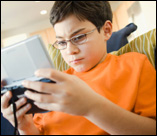
child with handheld game
image via cdc.gov

The American Academy of Ophthalmology has published a statement regarding the use of handheld 3-D games by children under age 6.

Nintendo recently started warning parents that young children could compromise their vision if they look at the 3-D games for long periods.  The AAO does not seem to think that warning is completely warranted:

At this time there are no conclusive studies on the short- and/or long-term effects of 3-D digital products on eye and visual development, health, or function in children, nor are there persuasive, conclusive theories on how 3-D digital products could cause damage in children with healthy eyes. The development of normal 3-D vision in children is stimulated as they use their eyes in day-to-day social and natural environments, and this development is largely complete by age three years.  Source:  AAO

Editor’s Note: Rather than worry about whether your young kids’ video games should contain 3-D graphics, why not get them to play outside instead?  A 2009 study comparing Australian children to children from Singapore showed that the Australian kids, who spent a lot more time outdoors were dramatically less likely to suffer from myopia or nearsightedness.


New DNA Test Available For Blinding and Fatal Batten’s Disease

The CEO of a Texas based biotech company, Craig Benson, was a father who thought that his five year old daughter needed new glasses. It turned out that she had the rare, and eventually fatal Batten’s disease. Batten’s disease is a disorder of the nervous system that leads to blindness, seizures, mental and physical impairment, and, eventually, premature death in the teens or early 20s.

Craig Benson has made it his mission to determine a way to develop DNA testing that will help potential parents determine if they are carriers of such debilitating diseases as Batten’s disease, muscular dystrophy, and other immune deficiency related conditions. For less than $400, parents can be checked to see if they are carriers of any diseases and whether the combination of their DNA and that of their partner make it likely that offspring would be born with any of the hundreds of conditions that can be picked up via this test. Source: ABC NEWS.

Batten’s disease affects an estimated 2 to 4 of every 100,000 U.S. born babies. It can be diagnosed by a neurologist with a number of tests including electrical studies of the eyes. Source: http://www.ninds.nih.gov/disorders/batten/detail_batten.htm

Nearsightedness Linked to Early Life Experiences

babies
image via cdc.gov

Myopia (also known as nearsightedness) is becoming increasingly common.  In just two decades the proportion of Americans who are nearsighted has increased by 11% to include about 36% of the population.

A new study published in Ophthalmology reveals a possible connection between early life and the development of myopia.  Several factors were found to contribute to the development of nearsightedness:

  • the age of the mother at birth (rates of myopia in children increase when moms are over 35);
  • birth weight (tinier babies are more likely to eventually develop myopia); and
  • maternal smoking in early pregnancy (children of moms who smoked are twice as likely to develop severe myopia).

Source:medscape.com

The study authors also note that kids who do lots of close work (including reading) at a young age are much more likely to become nearsighted.

The good news is that a condition like myopia is reversible.  Learn more at our website.

Omega-3s Aid Babies Vision and Brain Development

The European Commission is standing behind the claims that omega-3s help infants’ brain and vision development. The claims relate to both intake by the mother during pregnancy and lactation as well as directly by the baby.

The statements relate to specific compounds found in the fatty acids:

  • ALA contributes to the brain development of children
  • DHA has a structural and functional role in the retina and DHA intake contributes to the visual development of infants up to 12 months of age
  • DHA has a structural and functional role in the retina and maternal DHA intake contributes to the normal development of the eye of the foetus and breastfed infants
  • DHA has a structural and functional role in the brain and maternal DHA intake contributes to the normal brain development of the foetus and breastfed infants

Source: Nutraingredients

Protect Children’s Eye With Safe Gift Choices

As the holidays get closer, make sure that the gifts you give the children in your life do not endanger their eyes.

According to the U.S. Consumer Product Safety Commission toy-related injuries are on the rise; 186,000 kids under 15  went to the emergency room after toy-related incidents last year.

Prevent Blindness America offers the following tips and warnings specifically related to protecting children’s eyes:

  • Avoid toys that shoot or include parts that fly off.
  • Inspect toys for sturdiness. Your child’s toys should be durable, with no sharp edges or points. The toys should also withstand impact.  Dispose of plastic wrapping material immediately on toys as they may have sharp edges.
  • Make recommendations to family members and friends about gifts that you feel are appropriate for your child.  Be diligent about inspecting these gifts before allowing your child to play with them.
  • Inspect all toys before purchasing.  Monitor toys that your child has received as gifts to make sure they are appropriate for your child’s age and developmental level.
  • Gifts of sports equipment should always be accompanied by protective gear (such as a basketball along with eye goggles or a face guard with a new batting helmet for baseball or softball).

Children’s Eye Conditions Can Influence Socialization

Being accepted as a kid can be tough sometimes, especially if you have a “squint.”

According to a study published in the British Journal of Ophthalmology, young children whose eyes are obviously affected by conditions like strabismus are less likely to be invited to birthday parties than their unaffected identical twins.  The preference was much stronger after the age of six when nearly 50% of kids looking at pictures of children with squints noticed immediately that they were “different.”

The results of this study lead researchers to conclude that “schoolchildren with strabismus seem less likely to be accepted by their peers, so corrective surgery for strabismus should be performed before the age of six years, when negative social implications may arise.”  Source: https://www.irishhealth.com/article.html?id=17753

Learn more about other binocular conditions that can affect adults and children.

Blood Tests For Food Allergies in Children May Result in False Positives

food shopping
image via usda.gov

Blood tests for food allergies in children may not be as reliable as you think.

According to a study published in the Journal of Pediatrics 84 – 93% of foods that had been avoided due to blood test results could be reintroduced after passing “food challenges.”  Source: https://www.foodnavigator-usa.com/

This is not to say that we should ignore the ways that food allergies and sensitivities can impact health.  Diseases and conditions people suffer from can actually result from hidden allergies and sensitivities, including everything from rheumatoid arthritis to depression.

Learn more about common allergens and how lifestyle changes and supplements can help you manage food sensitivities.

Reduce Eye Pressure By Eating “Good Fats”

It is possible to reduce children’s intraocular pressure (or eye pressure) by ensuring that their diet is rich in polyunsaturated fatty acids and fiber.  Children were studied because they had fewer concurrent medical issues than adults that would potentially skew results.

The polyunsaturated fatty acids (PUFAs) are key sources of endogenous prostaglandins (fat derived compounds that are essential to the body’s proper function).  A diet rich in PUFAs helps aid eye health and reduces eye pressure, according to this study of information derived from the Singapore Cohort Study of Risk Factors for Myopia.

Researchers found that fiber helps to reduce upswings in blood glucose levels after eating.

Elevated intraocular pressure can lead to glaucoma and other damage to the optic nerve.

Source: https://www.pconsupersite.com/view.aspx?rid=75563


Tinted Glasses Can Help Kids Cope With Dyslexia

An article in the British newspaper, The Journal, talks about a middle school student who is coping with dyslexia thanks to a new pair of glasses.

Rose-tinted glasses help to reduce visual stress and stop the feeling that words and musical notes were “moving fast off the page.”

According to the eye doctor who fitted her with these special lenses, they chose a color not to make a fashion statement, but because rose was the best tint for her.  The glasses are intended to block out distortion and make images clearer and sharper.

According to optometrist Andrew Keyes, of Gosforth, UK: “Visual stress is a visual perception problem which makes it difficult to see clearly.  The contrast between printed words on a white surface can make letters appear jumbled or blurred.”

Source:  The Journal


Eye Screening Tests for Pre-Teens May Not Be Effective

When a middle school student goes in for an eye exam it is likely that the tests will do a fine job of detecting myopia (or nearsightedness), but there is a good chance it will miss other conditions like hyperopia (farsightedness) or astigmatism.

A study published in the Archives of Ophthalmology discusses the results of eye exams of nearly 4500 Australian 7th graders.  They found that the common visual acuity tests given to those adolescents were not able to effectively determine whether they suffered from hyperopia or astigmatism.

It’s never too early to start thinking about your children’s eye health.  It is important to think about eye health at any age. Learn about how to support your entire family’s eye health.