Smokers’ Life: How Smoking Changes Your Life (Infographic)

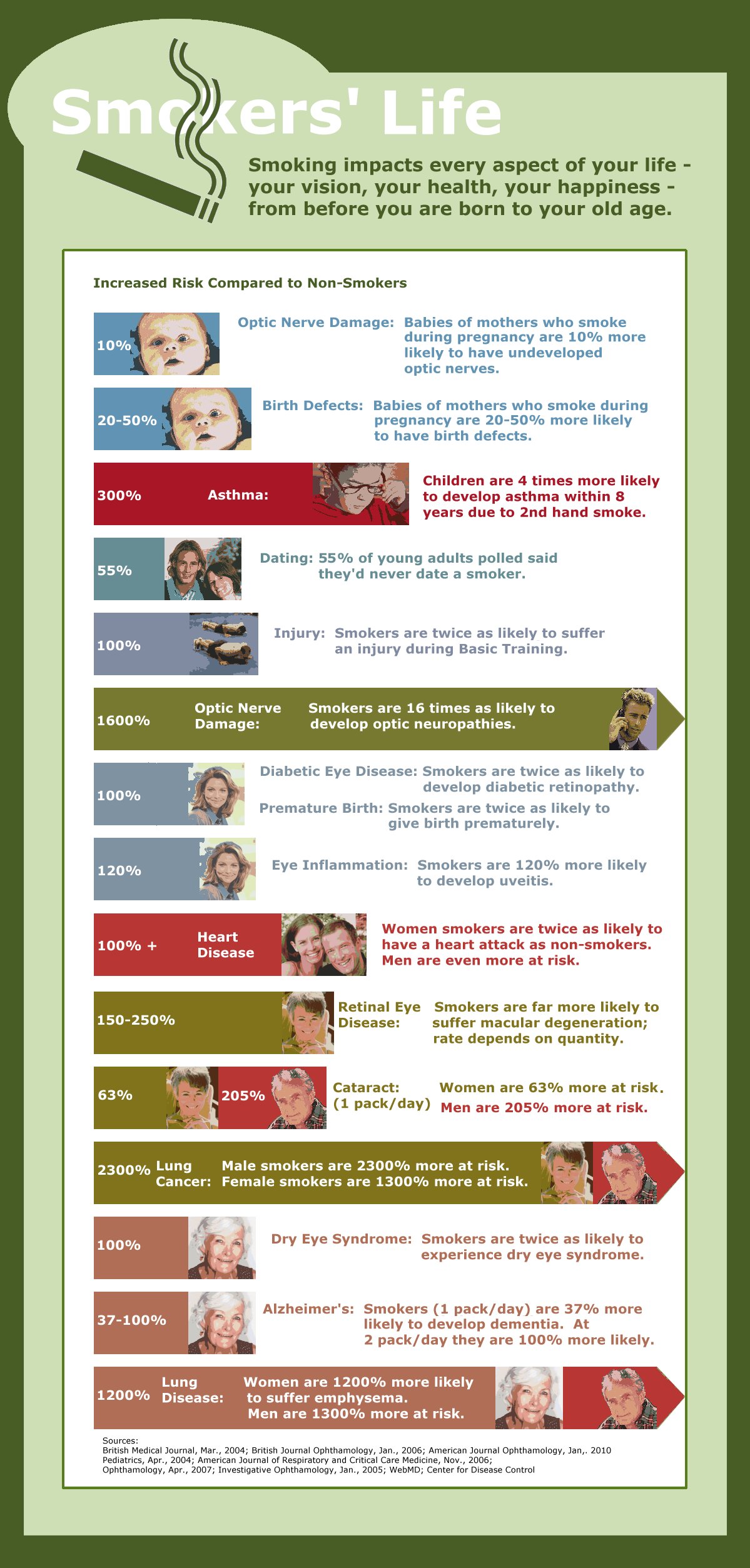
From before birth to the end of your life, smoking has a radical, nasty effect on your life: not only your health, but your social and mental life as well.  It impacts every aspect of your life – your vision, your health, your happiness – from the time in the womb until your old age.
Vision & Smoking

Share this image on your site!

Please include attribution to www.naturaleyecare.com with this graphic.

<p><a href=’https://oldblog.naturaleyecare.com/smokers-life-vision-health-infographic/’><img src=’https://oldblog.naturaleyecare.com/wp-content/uploads/2014/02/smokers-life.jpg’ alt=’Smokers’ Life! (Infographic)’ border=’0′ /></a></p>


 

Diminished Cognitive Function in Elderly Linked to Homocysteine

older cognitive function Homocysteine is an amino acid that can be measured with a simple blood test. The study, which appeared in the Journal of Affective Disorders in August 2013, studied 358 people aged 50 and up who had symptoms of depression.

They gave the subjects cognitive tests that looked at immediate and delayed memory, as well as global cognitive performance. They measured Continue reading “Diminished Cognitive Function in Elderly Linked to Homocysteine”

New Study Links Cerebrovascular Disease and Alzheimer’s

alzheimer cerebrovascular diseaseIn a new study that examined the association of cerebrovascular disease with a wide variety of neurodegenerative diseases, the strongest correlation was found to be with Alzheimer’s disease. Researchers from the Perelman School of Medicine at the University of Pennsylvania found that the link was strongest in younger Alzheimer’s patients, in whom the effects of cerebrovascular disease were most pronounced.

Cerebrovascular disease, which affects the circulation of blood in the brain, has previously Continue reading “New Study Links Cerebrovascular Disease and Alzheimer’s”

Eye Health Being Neglected In UK Care Homes

Eye health at elderly care homesGuest Blogger, Richard Keane

A new review has revealed that thousands of patients in UK care homes (nursing homes) are missing out on sight tests and acceptable standards of eye care. The review, compiled by the Thomas Pocklington Trust and the International Longevity Centre UK, claims that up to half of the 400,000 elderly people living in UK care homes suffer from sight loss that could be treated. Diseases prevalent in the elderly include glaucoma, cataracts, and macular degeneration. However, eye health is being neglected in the majority of homes, with some carers assuming that there is no need for sight testing in elderly patients, especially in the case of those with Alzheimers Disease (dementia), and a lack of national policy is causing eye care to fall low down on the list of care priorities.

Why is eye health being neglected?

The review cites a number of possible reasons for eye care neglect: firstly, eye care is not usually considered a threat to overall health and as a result it comes low on the list of priorities for care givers and nurses in nursing homes. Nurses are currently overstretched and they use their time to identify and treat problems they deem more harmful.

Continue reading “Eye Health Being Neglected In UK Care Homes”

Neurodegeneration Reversed by Novel Magnesium Compound MgT

BrainIs it possible to prevent or mitigate Alzheimer’s disease through supplementation? Researchers are looking at magnesium’s role in protecting the aging brain from the ravages of Alzheimer’s disease. A new, highly absorbent foam type of magnesium-L-threonate (MgT) concentrates in the brain and restores the types of brain deterioration found in Alzheimer’s disease and other types of memory loss. Experimental models predict  improvement in both short-term memory and long-term memory.

Magnesium is an important nutrient for proper brain functioning. Recent research has showed that magnesium specifically promotes memory and learning due to its beneficial effect on synaptic plasticity and density. Calcium and magnesium work together.

Continue reading “Neurodegeneration Reversed by Novel Magnesium Compound MgT”

Cancer Drug May Help Alzheimer’s Disease

alzheimer's patientThere is no cure for the degenerative brain disease called Alzheimer’s, and current conventional treatments have a limited effect. However, research into a drug used to treat skin cancer may show “stunning” potential to help with Alzheimer’s disease.


The drug is called bexarotene. So far, the experiments have only been done on mice. The research was done at Case Western Reserve University.

Alzheimer’s occurs in older people, and symptoms include a pattern of forgetfulness, disorientation,  misplacing things, short attention span, difficulty in performing routine tasks, poor judgment, language problems, problems with thinking, depression, irritability, paranoia, hostility, and lack of initiative. It is also called “Elderly Dementia.”

The disease is not fully understood, and its cause — or causes — are not yet clear. Patients with Alzheimer’s disease cannot properly clear the protein amyloid beta from their brains.  The excessive amount of the protein accumulate as plaque, which blocks synapses and kills nerve cells.

Bexarotene — also known as Targretin — wipes out amyloid beta. Continue reading “Cancer Drug May Help Alzheimer’s Disease”

Alzheimer’s Disease Onset Delayed In Bilingual People


Closeup portrait of a smiling elderly woman

Parlez-vous Français?

A new study in the journal Neurology indicates that speaking a second language can help fend off the development of neurological diseases like Alzheimer’s.

Research indicates that those who speak a foreign language are likely to be diagnosed with Alzheimer’s four years later than those who only speak one language.  Brain scans indicated that bilingual people demonstrate superior cognitive function even when they have more advanced brain deterioration when compared to their single language speaking counterparts.  Previous studies have established that speech and language issues are linked to dementia.  Source: https://www.foodconsumer.org/newsite/Non-food/Disease/language_delays_onset_of_dementia_0219110210.html


Certain supplements have been reported to aid in the prevention of Alzheimer’s including acetyl-L-carnitine, antioxidants, and B vitamins.  For an extensive discussion of complementary treatment for Alzheimer’s disease, please visit our website.


Excess Iron Linked to Alzheimers / Macular Degeneration

Alzheimer’s & Excess Iron

brain scan
image via nih.gov

While we often think of iron deficiency as a problem that causes anemia, researchers have found that excessive iron may increase one’s risk of developing Alzheimer’s disease.

Researchers publishing in the Journal of Alzheimer’s Disease state that some studies have found that accumulation of metals in the body, including copper, zinc, and iron, have been linked to the development of neurodegenerative diseases.  In particular, this study focuses upon  Alzheimer’s and Parkinson’s disease patients who demonstrated high levels of iron in their brains.  Source: https://www.foodconsumer.org

Iron and Macular Degeneration

Excessive iron in the body or hemochromatosis may lead to the wet form of macular degeneration.  Researchers at the Medical College of Georgia suspect that too much iron, known to have cumulative negative effects throughout body, can also speed the aging in the eyes.  If there is a link between iron levels and macular degeneration, people may be able to ward off the eye disease by donating blood a couple times annually to reduce iron levels the amount if iron in the body.

Source: https://www.eurekalert.org

Alzheimer’s Disease May Respond To Compounds in Green Tea

green tea
image via www.epa.gov

New studies are finding that Alzheimer’s Disease may be the result of the build up of β-amyloid peptides (Aβ) in the brain and green tea might be a good candidate for the clean up crew.  A green tea extract that was particularly bioavailable (the body was capable of absorbing its “good stuff”) was found to be capable of lower brain toxicity levels.  Source: Nutraceuticals World

Green tea can be a powerful source of antioxidants.  Other studies have found that people who take antioxidant supplements (vitamin C or vitamin E) have a lower risk of Alzheimer’s disease compared with people who do not take antioxidants. Preliminary research shows that higher blood levels of vitamin E correlate with better brain functioning in middle-aged and older adults.

Learn more about how nutrition and supplements can help ward off Alzheimer’s Disease.


Glaucoma and Alzheimer’s: Plaque Is A Potential Connection


Alzheimer's patient
image via www.cdc.gov

Glaucoma refers to any condition that causes damage to the optic nerve, but its cause is generally unknown.  Researchers in London are establishing a potential link between the development of glaucoma and the onset of Alzheimer’s disease.

In both cases, the same “plaque” proteins are involved in the conditions’ development.  Researchers speculate that the same substances that destroy brain cells in Alzheimer’s patients also destroy the optic nerve cells of those with glaucoma. Source: https://www.lef.org/

For more information about how to treat and prevent glaucoma naturally, visit our website.