Most People Search the Web for Medical Information, But Is That Info Accurate?

laptop
image by channah

You’re part of the global majority.  A new study out of the London School for Economics finds that 81% of people across the world who have internet access use the Web to research health information.

While this study’s researchers are glad that people are using technology to inform themselves about health issues, they do wave a flag of caution.  Study authors are concerned that only one quarter of questionnaire responders say that they check the sources of the medical facts that they find online.  Source: Medscape

When you find anything about health on this blog or at NaturalEyeCare.com you can be assured that the information is backed by peer reviewed scientific research and/or comes from Dr. Marc Grossman’s 30 years of experience as an optometrist and licensed acupuncturist.

For in depth information on the most common eye conditions and many other health problems, visit our research pages.

Diabetes and Depression Linked to Fatal Heart Attacks In Women

face in hands
image via healthfinder.gov

A new study out of the Harvard School of Public Health finds that women who have diabetes and/or depression are more likely to die of a heart attack than women without those conditions.

According to the study of nearly 80,ooo older women, those with depression were 44% more likely to die of a heart attack.  Those who had diabetes were 35% more likely to suffer a fatal heart attack.  Women with both conditions ran twice the risk of dying of a heart attack compared to those free of both depression and diabetes.

Source: lef.org/

Do your heart a favor and learn more about how to prevent and treat diabetes.

Glaucoma Breakthrough: Researchers Gain Insight Into Origins of Glaucoma in Mice

New examinations of the optic nerve of mice have yielded new insight into the development of glaucoma. Scientists better understand both the cellular and molecular structure of this part of the eye, a discovery that will pave the way for a better understanding of the human eye.  This breakthrough should hasten the development of new therapies that will help to combat the potentially devastating effects of glaucoma.

Researchers discovered a unique class of cells called astrocytes that seem to play an integral role in the development of glaucoma.  They also learned more about a certain protein called gamma synuclein; abnormalities in this protein can result in eye disease.  Another exciting discovery, which may influence the way science looks at a number of neurodegenerative diseases, involves the way that neurons clear away debris from the optic nerve.  Essentially, the cells’ failure to clean up after themselves can lead to their own demise.

Source: https://www.medicalnewstoday.com/articles/212650.php


Embryopic Stem Cell Research for Macular Degeneration Approved

test tubes
image via atp.nist.gov

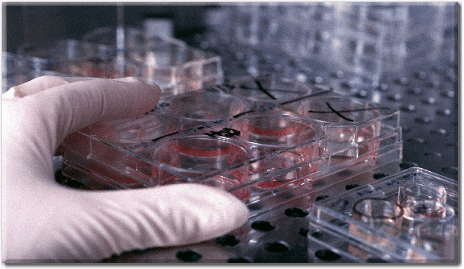
The Food and Drug Administration has just approved the use of human embryonic stem cells to treat macular degeneration.

The company, Advanced Cell Technology, is already doing research on the use of stem cells to treat people with another condition related to progressive vision loss, Stargardt’s disease.  Source: Medscape

Though the general consensus in the medical community generally has it that macular degeneration inevitably leads to blindness, there are natural treatment options out there that can halt and even reverse the progression of the disease.

Prostate Cancer Treatment Linked to Cataracts

Hormone therapy has been proscribed to some men suffering from prostate cancer.  Unfortunately, this treatment has been linked to cataracts according to a study published in the Annals of Epidemiology.

Research shows that study participants on hormone therapy were 9% more likely to develop a cataract compared to those who were not treated with hormone therapy.  In men whose testicles had been removed the risk soared to 26%.  The study involved 66,000 prostate cancer victims.

Learn more about natural cataracts prevention and treatment at our website.

For more about drugs that can harm the eyes, have a look at this page.

Mercury in Fish Can Increase Blood Pressure: Find Omegas in Other Sources for Heart and Eye Health

Your new year’s resolutions may well include eating better, both for the health of your heart and the health of your eyes.  The essential fatty acids found in fish can be a great addition to your diet.

In particular, omega-3 fatty acids help to reduce cholesterol and increase circulation to the retina.  Omega-6 fatty acids are important as they protect cells from degenerative changes and reduce inflammation throughout the body. Both Omega 3s and 6s help prevent and even treat glaucoma and macular degeneration.

ocean
image via noaa.gov

A word of caution about your fish intake the effect of mercury which contaminates the larger ocean predator fish (tuna, swordfish, marlin, sharks, etc): too much mercury in the body can raise your blood pressure.

Source: theheart.org/article/1010897.doc

Small fish like sardines are a safe choice, but there are non-swimming sources of essential fatty acids out there too.  Find omega-3s in flax seed oil, black current oil, walnuts and walnut oils, dark leafy vegetables, eggs (preferably from free range chickens), spices (including mustard, fennel, cumin, and fenugreek).  Get your omega-6s from evening primrose, borage and black currant oils.


Learn more about food sources of nutrients and how they can benefit your eyes and your whole body.

Avoid Eye Injury: Careful When You Pop the Champagne Corks Tonight

champagne cork
image by egomedia

Every holiday tends to be accompanied with a few unique safety concerns.  In the case of New Year’s Eve: beware of the popping champagne cork.

According to the American Academy of Opthalmology a cork can shoot out of a champagne bottle at up to 50 miles per hour.

    • Make sure sparkling wine is chilled to at least 45 degrees Fahrenheit before opening. The cork of a warm bottle is more likely to pop unexpectedly.
    • Don’t shake the bottle. Shaking increases your chances of eye injury.
    • To open the bottle safely, hold down the cork with the palm of your hand while removing the wire hood. Point the bottle at a 45-degree angle away from yourself and from any bystanders.
    • Place a towel over the entire top of the bottle and grasp the cork.
    • Keep the bottle at a 45-degree angle as you slowly and firmly twist the bottle while holding the cork to break the seal. Continue to hold the cork while twisting the bottle. Continue until the cork is almost out of the neck. Counter the force of the cork using slight downward pressure just as the cork breaks free from the bottle.
    • Never use a corkscrew to open a bottle of champagne or sparkling wine.

Source: https://www.aao.org

And one other thing to keep in mind: a dramatic popping cork like they have in the movies will undoubtedly lead to a lot of spilled champagne.  Open the bottle carefully so you can enjoy what’s inside!

Anti-Inflammatory Medications May Slow Macular Degeneration, But Are They Safe?

Macular Degeneration
nlm.nih.gov

Researchers have found that taking anti-inflammatory medication may slow the progression of macular degeneration. But, there are concerns about the safety of this “solution.”

A study published in the journal Eye describes how corticosteroids, nonsteroidal anti-inflammatory drugs (NSAIDs), immunosuppressive agents (e.g. methotrexate and rapamycin), and biologics could help those with AMD. Source www.nature.com

A caveat to the research indicates that there are concerns about the long term safety of taking such drugs.  At Natural Eye Care we are very concerned about the way that prescription and non-prescription pharmaceuticals can harm the eyes.

For example, NSAID drugs like aspirin, ibuprofen, and naproxen can cause eye hemorrhaging, glaucoma, and cataracts.

Chest Pains Linked to Family Stress

heartTime with your family can either do your heart good or can do quite the opposite.

A study out of Denmark shows that worries over family situations can lead to chest pains or angina.  The study included over 4500 middle aged people who filled in questionnaires about their own health over a six year period.

Over the six years 9% developed angina.  Problems with spouses increased the risk of developing angina by a factor of three; those who had trouble with their kids were doubly likely to develop chest pains.  Issues with relations that were not as close did not seem to effect the heart.  Source: https://www.theheart.org/

The health of the body and the health of the eyes are intimately connected.  Follow our wellness protocol for your eyes and realize benefits for you heart as well.

10 Million Dollar Grant for Retinal Disease Research

The National Eye Institute has just given researchers at Case Western Reserve University School of Medicine a $10.1 million grant to study and develop new treatments for diseases that affect the eye’s retina.  Part of their research will focus on the development and treatment of macular degeneration and Stargardt’s Disease.

Researchers will be looking at how the eye metabolizes essential vitamin A and how it deals with the toxic byproducts of that process.  If the build-up of those byproducts is not managed by the body properly then one is likely to develop eye disease.  Source: https://www.physorg.com/wire-news/54994484/case-western-reserve-receives-10m-to-study-retinal-disease-devel.html

Because this grants is in part funded by the Food and Drug Administration, researcher will focus on analyzing the effectiveness of current drugs and formulating new pharmaceutical options.

At Natural Eye Care, we advocate taking a natural approach to eye disease prevention and treatment.  Learn more about how to prevent and treat macular degeneration naturally.