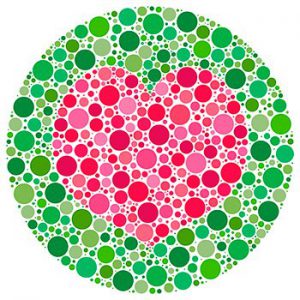
Research on Reversing Color Blindness

Approximately eight per cent of men and one-half of one per cent of women in the U.S. have a problem with their color perception.

Most colorblind people have lost only part of their color vision. Usually, only one or two types of cones are either absent or not functioning normally. If the dysfunction is in green cones, a person will be deficient picking up green. However, red and blue colors and combinations of red and blue will still be seen. Continue reading “Research on Reversing Color Blindness”

Rod-Cone Dystrophy – A Complete Overview by Natural Eye Care

rod-cone-dystrophy-200Rod-Cone Dystrophy is a genetically-based deterioration of vision caused by damage to the photoreceptors in the eye. Rods and cones are the photoreceptor cells in the retina that give us daytime and night time vision. Genes that provide the blueprint for manufacturing proteins crucial to the eye’s rods and cones are damaged. Without enough of these proteins, vision deteriorates and blindness may result.

Much of the current research into rod-cone dystrophy is focused on genetic research. Scientists are busy identifying the faulty genes and how they function. Stem cells or other genetic therapy offers hope for a treatment and possibly cure in the future. In the meantime, nutritional and lifestyle choices may Continue reading “Rod-Cone Dystrophy – A Complete Overview by Natural Eye Care”

Contacts May Help the Color Blind

A special contact lens might be able to help people with color blindness.

A report to the European Society of Cataract and Refractive Surgeons described how a custom color spectrum-correcting lens may be able to alter the way that color blind people see color.  The secret is in the digital diagnostic tool that determines the nature of patients’ color perception problems and helps inform the creation of custom lenses.

The special lenses were tried on 300 people in China.  According to researcher Mitsugu Shimmyo, MD, “Our lenses rebalance color perception by filtering and redistributing the intensity of color spectrum.”

Source: http://www.osnsupersite.com

A Step Towards a Cure for Color-Blindness

Researchers from the University of Washington and the University of Florida have used gene therapy to cure two monkeys of color blindness. 

An article published online in the journal Nature discusses the potential for this type of gene therapy to treat adult vision disorders involving cone cells, including color blindness and other retinal diseases.

Color blindness is an inherited disorder caused by a single defective or absent gene.  Jay Neitz, a professor of ophthalmology at the University of Washington (U.W.) School of Medicine and senior study author and his wife Maureen Neitz, also in the U.W. ophthalmology department, have identified this particular gene and developed a working virus vector to carry a functional copy of it.

Researchers injected the gene-carrying virus into the monkeys’ eyes. In about 20 weeks the monkeys attained full color vision and have shown no harmful side effects.

Color-blindness is a common genetic disorder, affecting more than 3.5 people in the United States, including about 8% of Caucasian men, leaving them unable to distinguish between red and green hues.

The research team hopes to be able to translate the findings into clinical trials for humans. The team used human genetic material in the monkeys in the interest of expediting future research.

SOURCE:  Colour blindness corrected by gene therapy, Nature doi:10.1038/news.2009.921