
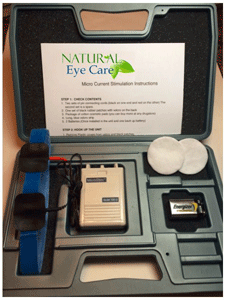
 Microcurrent Stimulation treatment protocols are designed to help people with retinal disease. MCS works by supporting nourishment and healing to the back of the eyes as well as possibly some cell regeneration. Retinal tissue is easily the most complex tissue in the entire body, and we tell people that they need to commit to regular treatment for a year, because it may take up to a year before they first see results, though benefits may be seen much sooner.
A number of research studies have suggested that daily use of specific microcurrent stimulation helps promote retinal (as well as optic nerve health) in 3 different ways: Continue reading “Microcurrent Stimulation for Eye Disease (and more)”
 Did you know that how well your gut works is directly related to your healthy vision and your healthy brain?
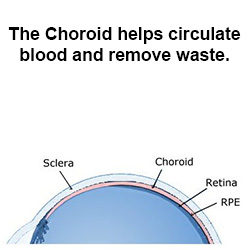 The eye has a delicate vascular system. Eye circulation brings oxygen and nutrients to the eyes. It also removes waste products. The “choroid” is the part of the eye that circulates blood. Fats and blood clots that damage the arteries can also clog the arteries and veins in the eyes. This condition is common as people age. Poor circulation is associated with many eye diseases:
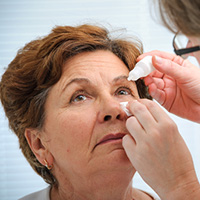 Eye drops may soon replace gene therapy injections for Age-Related Macular Degeneration and Diabetic Retinopathy. [1. “Facile Noninvasive Retinal Gene Delivery Enabled by Penetratin” by Chang Liu, Kuan Jiang, Lingyu Tai, Yu Liu, Gang Wei, Weiyue Lu, and Weisan Pan. ACS Applied Materials & Interfaces, 2016, 8 (30), pp 19256–19267 DOI: 10.1021/acsami.6b04551 Publication Date (Web): July 11, 2016] Delivering drugs to the back of the eye currently requires an invasive injection. The associated discomfort discourages many patients from consenting to this type of treatment. The new delivery technique is special eye drops that gently make their way to the back of the eye.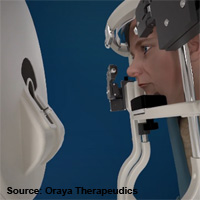
 In the case of choroidal neovascularization (CNV, also known as “wet” macular degeneration), new blood vessels are the cause of the problem. Yet normally when new blood vessels are created in the body, it is a good sign. For example, it is part of the way the body heals wounds. But with CNV, the blood vessels pose a problem because they originate in the choroid layer of the eye and pass through a weak part of the Bruch’s membrane, the innermost layer of choroid, then pass into the subretinal pigment epithelium (sub-RPE) or subretinal space. These blood vessels aren’t supposed to exist in this part of the eye, are weak and tend to leak, potentially substantially impairing vision.

 As people age, eye diseases and conditions that commonly occur include macular degeneration, cataracts, vitreous tears/retinal tears and detachments, glaucoma, diabetic retinopathy, dry eyes, and eye floaters.
 Increase in the delivery of a treatment for neovascular age-related macular degeneration (wet AMD) has resulted in a significant 50% reduction of new cases of blindness in Denmark, according to a study published in the American Journal of Opthamology. Age-related macular degeneration is the most common cause of blindness in the West. Specifically, AMD patients lose reading vision and their ability to drive, resulting in revocation of their drivers’ license.