Sense of Touch Improves With Practice – Important Discovery for Braille Learners

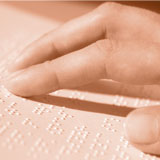
reading braille
Image via ops.fhwa.dot.gov

Canadian researchers have published a paper that seeks to answer whether blind people enjoy an enhanced sense of touch because their brains are compensating for sight loss or because they use their fingertips to do so much.

According to the study, published in the Journal of Neuroscience, it is the regular use of their fingertips to learn about their environment that explains blind individuals’ keen sense of touch.

In a trial that included 28 blind subjects and 55 sighted subjects, all were tested for sensitivity in their fingers and in their lower lips.  According to the source for this story, Medical News Today, “Researchers reasoned that, if daily dependence on touch improves tactile sensitivity, then blind participants would outperform the sighted on all fingers, and blind Braille readers would show particular sensitivity on their reading fingers. But if vision loss alone improves tactile sensitivity, then blind participants would outperform the sighted on all body areas, even those that blind and sighted people use equally often, such as the lips.”

It turns out that blind participants who read Braille performed markedly better on the fingertip sensitivity test, while all participants scored equally when it came to the powers of sensation in the lips.  Scientists are hoping to apply this knowledge to finding ways to improving the sense of touch, which is particularly important to those who become blind later in life and find it very difficult to master Braille.
 

Electrical Stimulation Therapy Can Help Retinitis Pigmentosa Patients

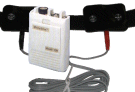
electrical stim machineA new study of how electrical stimulation therapy (EST) can potentially help retinitis pigmentosa patients has recently been presented.

The study, performed by Okuvision GmbH and published in Investigative Ophthalmology & Visual Science, involves stimulating the eye’s retina with small amounts of electrical current.  According to the source of this story, Medical News Today, “the findings from this study emphasize that electrical stimulation of the retina liberates growth factors which may be able to delay retinal degeneration.” Source: https://www.medicalnewstoday.com/articles/224224.php

For more research on treatments for retinitis pigmentosa, please visit our research pages.

We offer a microcurrent stimulation device that many patients have found improves eye conditions including macular degeneration by stimulating energy production (ATP) in the retina, improving circulation and reducing waste build-up.

Diabetic Retinopathy: New Video Diagnostic Technology


Diabetic retinopathy should be easier to detect with a new video imaging technique being developed in Australia.

At the Asia Pacific Academy of Ophthalmology (APAO) Congress researchers presented on how retinal video recording is as accurate at detecting diabetic retinopathy as the commonly established diagnostic practices – still photography and slit lamp examination.  The initial trial involved 200 eyes at the Royal Perth Hospital.  According to presenter Dr. Daniel Ting, Digital video “is able to image a larger area of retina within a shorter period of time, compared to the conventional retinal still photography.  It also provides a good continuity of retinal information and is less dependent on the cooperation of the patients who may move or lose focus during the process of still photography.”

It is hoped that the technology will allow Australian primary healthcare providers to do in-office screenings rather than current diagnostic practices that require more time and specialized training.

Source: VirtualMedicalCentre

For more information on diabetic retinopathy research, visit our website.


Advances in Retinal Implants May Help Macular Degeneration Patients

Scientists are developing new technologies that will make retinal implants better.  When diseases like macular degeneration or retinitis pigmentosa become so advanced, some people may choose to turn to surgically implanted artificial retinal devices.

Existing technology has made it possible for a signal sent from a video camera attached to a pair of glasses to transmit images to device placed on a person’s retina.

New advances at the Italian Institute of Technology show how using organic polymer semiconductor can improve the quality of the images and prevent retinal scarring. They are actually developing ways for this special semiconductor to communicate with the neurons in the brain.  Researchers are hoping these new techniques will eventually allow people with the implants to see more clearly and also see in color, not just black and white.

Source: https://www.technologyreview.com/

Retinal implants are not for everyone.  It is possible to slow the progression of degenerative eye diseases without surgery. Learn more about how to slow, stop, or even reverse the progression of diseases like macular degeneration and retinitis pigmentosa on our complementary treatment pages.

Prevent Cataracts and Auto Accidents With Good Sunglasses

Do you trade in your prescription lenses for a pair of drug store sunglasses on days when the glare is bothering you?  A new study by eyeglass lens maker Essilor of America finds that 20% of people will drive without any corrective eyewear on sunny days because they do not have prescription sunglasses.  The source for this story, www.medicalnewstoday.com, goes on to describe the importance of polarized lenses, especially when driving in high-glare situations.

Protecting your eyes from the sun is a key part of our eye disease prevention protocol. Cataracts can be caused by exposure to sunlight, so always remember your sunglasses with 100% UVA and UVB protection whenever outside in the sun.

Breakthrough: Microchip Implant Restores Partial Sight

For the first time, scientists have restored the ability of previously blind patients to recognize letters, fruit and other items using light-sensitive microchips implanted in the inner surface of the eye.

For the first time, scientists have restored the ability of previously blind patients to recognize letters, fruit and other items using light-sensitive microchips implanted in the inner surface of the eye.

The microchip is only approximately 3 millimeters by 3 millimeters in size, but is loaded with 1,500 light detectors that send a grid of electrical impulses through a patient’s nerves to generate a 1,500-pixel image. The device is implanted under the retina, the inner lining of the eye unlike other implants that sit outside the retina and require users to wear an external camera. Since the chip requires a sharp image, the patients wear reading glasses.

For information on natural eye care, go to www.naturaleyecare.com

In a paper published in The Procedings of the Royal Society B researchers describe how three patients suffering from hereditary retinal dystrophy regained the ability to identify objects and people and even read words printed in large letters.  The technology involves that natural projection of images through the eye’s lens onto a chip placed under the transparent retina.

Source: http://rspb.royalsocietypublishing.org/content/early/2010/11/01/rspb.2010.1747.abstract

Contact Lenses: Potential Problems With Long-Wearing Silicone Hydrogels

contact lens
image by jdurham

Researchers have found that people who wear silicone hydrogel (SH) contact lenses are likely to suffer corneal staining (mild abrasions of the eye), but that these situations rarely turn into more serious corneal infiltrative events.  Corneal infiltrates are marked by eye discomfort, feeling like there is something in your eye, light sensitivity, and conjunctival hyperemia.

Factors likely to cause these more serious corneal infiltrates include smoking and the presence of bacteria on the lens.  Smoking is a factor in the development of many other eye diseases as well – including everything from dark circles under your eyes to macular degeneration.

Silicone hydrogel lenses are purported to allow more oxygen to the eye and are designed for long term use (up to 3o days in some cases).  SH lenses on the market include:  Ciba Focus Night & Day, Acuvue Oasys, and Bausch and Lomb’s PureVision lenses.

Source: Medscape

Tinted Glasses Can Help Kids Cope With Dyslexia

An article in the British newspaper, The Journal, talks about a middle school student who is coping with dyslexia thanks to a new pair of glasses.

Rose-tinted glasses help to reduce visual stress and stop the feeling that words and musical notes were “moving fast off the page.”

According to the eye doctor who fitted her with these special lenses, they chose a color not to make a fashion statement, but because rose was the best tint for her.  The glasses are intended to block out distortion and make images clearer and sharper.

According to optometrist Andrew Keyes, of Gosforth, UK: “Visual stress is a visual perception problem which makes it difficult to see clearly.  The contrast between printed words on a white surface can make letters appear jumbled or blurred.”

Source:  The Journal


Improving Vision In Athletes – And the Rest of Us

pewee baseball
image via santabarbaraca.gov

A survey of Italian coaches, trainers, and physical education teachers sought to determine attitudes toward vision correction in athletes.  Those interviewed believed it was important to correct vision problems during sports, but they were not likely to recommend that their athletes try contact lenses.  Coaches who wore contacts themselves, however, were more likely to suggest them to sports participants.

The researchers, who published their findings in Contact Lens and Anterior Eye, believe that education is key to helping more athletes find solutions to their vision deficits. Source: ScienceDirect

Another solution besides corrective lenses may be the daily practice of eye exercises. (You don’t even have to be an athlete to do them!)

Learn more about how to prevent and treat myopia (nearsightedness) naturally.

iPhone Good Enough for Eye Doctors to Examine Patients’ Results

Maybe they will start calling it the EyePhone…

At the  American Academy of Ophthalmology (AAO) – Middle East-Africa Council of Ophthalmology (MEACO) Joint Meeting in Chicago researchers described how images on the iPhone are of high enough quality that they can be used by eye doctors who want a portable way to carry around patients’ diagnostic images.

It is common for images of patients’ eyes to be viewed on a computer screen, but researchers at the University of Pittsburg School of Medicine decided to see if they could jump on the portable device wagon.

The study involved the office visits of over 100 patients with diabetic retinopathy.  For some, the examining doctor relied on computer screens to evaluate images of the eyes and for others, the iPhone.  According to Dr. Michael J. Pokabla. “There were no significant differences between evaluations and recommendations using the two different systems, and the doctors rated the iPhone images as excellent. We conclude that mobile devices like the iPhone can be used to evaluate ophthalmic images.”

Source: https://www.medicalnewstoday.com/articles/204895.php