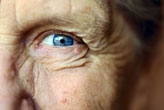
Baby Boomer Natural Eye Care in the 21st Century

As the “Baby Boomer” generation in the United States approaches their 60’s and beyond, the incidence of eye disease in this aging population will rise. Eye problems become more prevalent as an individual ages. What are the most common eye diseases in older people? How can eye geriatric eye disease be prevented and addressed naturally? And what does Baby Boomer natural eye care look like?

Macular Degeneration

A major reason for visual impairment and blindness in adults aged 50+ is Macular Degeneration, also known as ARMD (Aged-Related Macular Degeneration). Vision in the center of the visual field is impaired, but peripheral vision remains. People with macular degeneration have difficulty writing, driving, recognizing faces and reading. Symptoms include:

  • Colors look dim
  • Words appear blurred or difficult to read
  • Straight lines look wavy
  • Dark or blank areas block the center of your vision
  • Distinct shapes are blurry
  • Fog in the center of your vision

Anyone with any of these symptoms should Continue reading “Baby Boomer Natural Eye Care in the 21st Century”

Liver Meridian Congestion May Cause Eye Floaters

Eye floaters are clumps of protein that may look like dots, squiggles, strands or any of a hundred other shapes. Though annoying, floaters are harmless, and there are ways to prevent them through proper diet. They commonly result from the natural aging process where the vitreous gel (that keeps the shape of the back of the eyes) starts to liquefy, resulting in gel pulling on the retina (people who are nearsighted are also at a greater risk of eye floaters). This results in protein debris being released into the vitreous gel that are referred to as “floaters”.

From a Chinese medical perspective, the body recognizes the eye floaters as debris, and there is an energetic process within the eyes that slowly works on breaking down the floaters. The best way to support this process is by strengthening the Liver (meridian) which in Chinese medicine opens to the eyes, and is the primary flow of energy responsible for healthy vision.  A common Liver tonic used in Chinese medicine is called “Rambling Power” or “Xiao Yao San”).

The Revision formula is based on this formula with additional eye nutrients added.

Read more about eye floaters.

Generally speaking, when the liver meridian is out of balance spicy foods can aggravate it further, and the person tends towards irritability.

Other common signs of liver meridian imbalances include dry, brittle, thickened nails and pain just below the ribs. Common illnesses include migraines, eye problems, and sinus problem and may experience frequent headaches on the top and sides of the head. Liver meridian imbalances can be especially noticeable in the dry windiness of autumn, windy March, and the very hot weather of late summer.

A lifestyle recommendation for general liver meridian imbalances is mild exercise, reading, plenty of rest.

Source: Acupuncture Today

Depression Can Increase Likelihood of Developing Diabetic Retinopathy

Depression & Diabetic Retinopathy
Image via nimh.nih.gov

The brain and the body are in constant relationship.  This truth is further supported by the recent study published in General Hospital Psychiatry that describes how people who suffer from both depression and diabetes are more likely to end up with diabetic retinopathy.

In a study that controlled such factors as obesity, smoking, and activity, diabetic retinopathy was linked to occurrences of depression.  Over the five year trial, almost one quarter of patients with depression developed the eye disease compared to less than 20% of those who did not have depression.  Researchers extrapolate that depression increases one’s risk of developing retinopathy by 15%.

According to study co-author Wayne Katon, M.D., “Our findings suggested that psychobiologic changes associated with depression such as increased cortisol levels and activity of blood-clotting factors may be linked to the development of retinopathy.”

Learn about self-help ideas for those concerned about diabetic retinopathy and diabetes.

Source:www.medicalnewstoday.com, July 29, 2011

Glaucoma Associated with Metabolic Syndrome

image via www.nih.gov

Don’t just take it from us that glaucoma risk increases in those who have diabetes, high blood pressure, and who are overweight.  Researchers publishing in the journal Ophthalmology have found that these conditions, which together are labeled “metabolic syndrome” are all linked to the development of open-angle glaucoma.

A staggering 20% of people in America are said to have metabolic syndrome.  Both metabolic syndrome and glaucoma are associated with aging, so, as the US population gets older, scientists believe that both conditions with become more prevalent.

This study included over two million adults over age 40.  The study authors analyzed the results from the subjects’ eye care records to discover the correlations between metabolic syndrome and glaucoma.  According to this story’s source, PCON Supersite, “Raw data showed that 1,576,993 subjects had at least one metabolic disease; 55,090 subjects had OAG.”

PCON Supersite goes on: “Adjusted data showed that subjects with diabetes alone had a 35% increased risk of developing OAG, and those with hypertension alone had a 17% increased risk. Those with diabetes and hypertension combined had a 48% risk. Those with hyperlipidemia alone had a 5% decreased risk. Obese subjects had a 14% increased risk.”

Learn more about your glaucoma risk factors.


Visual Perception Shifts As We Age

Is it harder to “see the bigger picture” as we get older?  New research published in Cortex indicates that as people age, the brain is less able to process information in the wider visual field.

A study of young and elderly people showed that the older subjects found it harder to focus on the “global picture.”  The participants were shown a figure similar to that which appears below.  Smaller letters made up a larger letter.  The elderly study subjects took longer to spot the larger letter.

According to Medical News Today, this experiment provides insight into the processes of aging, including the changes in attention (meaning, the ability to concentrate on one thing, while ignoring other) which naturally happen over time.

E E E E E
E
E
E E E E
E
E
E

Source: Medical News Today, 24 Jul 2011

New Device Makes “Lazy Eye” Test for Children Easier

Lazy Eye Test
Image via NIH.gov

Amblyopia, or lazy eye, is a condition that affects 3-5% of children.  Early detection is key, and a new test developed by doctors at Children’s Hospital Boston looks to determine whether kids as young as 2 years old have the condition in just a few seconds.  Amblyopia is potentially blinding because the brain will actually lose the ability to process visual information from the weaker eye.  It is important that toddlers and preschoolers get tested because it is often too late to fully correct the problem in school aged children.

This new device called the Pediatric Vision Scanner appears in a July 7 article in Investigative Ophthalmology and Visual Science.  The tool uses laser technology to measure the eyes’ alignment.  Source: Medical News Today, July 9, 2011

Learn more about binocular conditions that affect the eyes’ ability to effectively work together.

Retinitis Pigmentosa: New Drug Trial

Image via HHS.gov

Valporic acid is now being tested on human patients suffering from autosomal dominant forms of retinitis pigmentosa (adRP).  This drug has already been approved for people with seizures, but the National Eye Evaluation and Research (NEER) network is now looking at how the drug can help those with this inherited form of RP.

Participants in the trial are taking the medication orally through the duration of the trial.  Some will be treated with a placebo.  Visual field tests will help researchers determine the effectiveness of this treatment.

Source: https://www.medicalnewstoday.com, July 7, 2011

Certain nutrients such as vitamin A, lutein, omega-3 fatty acids, other antioxidants, and COQ10 may help slow down retinitis pigmentosa and help to preserve vision.


Glaucoma Is About More Than Elevated Eye Pressure

GlaucomaThe role of intraocular pressure (a.k.a. IOP or eye pressure) and glaucoma is still a point of discussion.

At a meeting of the World Glaucoma Association, speaker Felipe Medeiros, MD described a common myth: “21 mm Hg threshold, above which IOP is supposed to be abnormal and below which is thought to be normal.”

In fact, according to this story’s source, the OSN Supersite, only 9.5% of patients with what is considered a high IOP are ever diagnosed with glaucoma.

Dr. Medeiros told the audience that corneal thickness is actually a major predictor of one’s likeliness of developing glaucoma.  Those with thinner corneas run a higher chance of developing the condition.

At Natural Eye Care, we tell our clients and patients about a host of other factors that may influence one’s likelihood of developing glaucoma including genetics, diet, and stress levels.

Socioeconomic Status & Glaucoma

A British study finds a correlation between “social deprivation” and the development of glaucoma.

The researchers specifically looked at acute primary angle closure and used Index of Multiple Deprivation and Townsend scores to determine a relationship between glaucoma patients conditions and socioeconomic and racial backgrounds.

Source: https://bjo.bmj.com/content/94/10/1304.abstract

Macular Degeneration Twins Study Results

Image via nlm.gov

A diet that includes vitamin D, betaine and methionine can help to lower your risk of developing macular degeneration (AMD).  A study of identical twins conducted by the Tuft Medical Center also supports the assertion that smoking increases one’s chance of getting AMD.

AMD tends to run in families, and this opportunity to look at twins who exhibit different stages of the disease allowed researchers to zero in on how diet and lifestyle habits affected the condition’s progression.

According to the source of this story, Science Daily, Vitamin D, which is added to many milk products, may reduce the risk of AMD because it has anti-inflammatory properties.  Betaine (contained in fish, grains, and spinach) and methionine (found in poultry, fish, and dairy products) both seem to work at the DNA level to slow the progression of the disease.

This study was published in the July 1 issue of Ophthalmology.

Diabetes: Insufficient Water Intake Linked to Blood Sugar Problems

Here’s another reason to stay well-hydrated this summer: drinking at least 34 ounces of water each day can cut your risk of developing high blood sugar (hyperglycemia).

A French study shows that people who drink at least four eight ounce glasses of water per day were 21% less likely to develop hyperglycemia over a nine year period compared to those who had less than 16 ounces each day.

The report was presented at the annual meeting of the American Diabetes Association.  Prediabetes, which is marked by elevated blood sugar levels, affects nearly 80 million American and greatly increases one’s risk of developing full blown diabetes and its accompanying eye condition, diabetic retinopathy.  Source: WebMD

When you’re drinking that extra glass of water today, remember that increasing your water intake to a recommended eight glasses per day can also help you deal with dry eyes.