
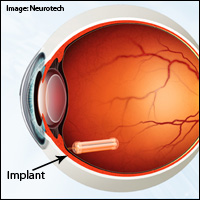
 Clinical trials are underway for an implantable device that delivers medication directly to the eyes of people with age-related macular degeneration. Current treatment involves eye injections every four-to-eight weeks, which is difficult to comply with and can create complications. The new technology is a tiny device that is put into the eye and lasts up to 2 years, reducing or eliminating the need for the injections. The devices are being developed by Cumberland, Rhode Island-based Neurotech. Continue reading “Avoid Eye Injections for Macular Degeneration with Encapsulated Cell Therapy (ECT)”
Rod Opsin Human Protein May Restore Vision for Retinitis Pigmentosa Patients
 Experiments on mice show promise for a treatment that expresses a light-sensitive human protein, called rod opsin, on the undamaged retinal cells. These cells are turned into photoreceptors, which allow vision.
Retinitis pigmentosa is a group of eye disorders that appear to be genetic. This eye disease is a major cause of vision loss and blindness. Continue reading “Rod Opsin Human Protein May Restore Vision for Retinitis Pigmentosa Patients”
Genetic Variant and Vitamin D Deficiency Linked to Macular Degeneration
 Women with specific genes may be more likely to develop age-related macular degeneration (AMD) if they are deficient in Vitamin D, according to new research in JAMA Ophthalmology.
The genetic variant (Y402H) studied is the complement factor H gene, called CFH for short. The genes in question are related to the immune system. The development of macular degeneration is believed to involve inflammation. In AMD, drusen, lipids (fats) and proteins build up in the eye. The body perceives the drusen to be an invader and attacks it. The genes appear to cause a stronger immune response. Continue reading “Genetic Variant and Vitamin D Deficiency Linked to Macular Degeneration”
MSM Fights More Than Inflammation
 Methylsulfonylmethane, known as MSM, is commonly utilized in the form of MSM eyedrops or powder in vcaps to be taken as a supplement. It is well known for its anti-inflammatory capacity, documented by researchers. Scientists are documenting substantiating research and finding new uses.
Anti-Inflammation
MSM inhibits inflammasomes, which are protein formations that stimulate production of lymphocytes (white blood cells). It also inhibits the activity of ‘pro-cytokines’ which promote inflammation throughout the body, creating health-damaging fevers and causing tissue death and shock.1 This effect of MSM is useful in reducing the tissue swelling that damages the optic nerve, causes eye soreness of dry eyes and Sjogrens syndrome and other inflammatory-related conditions.
Eyebright Fights Microbes and Inflammation
 European researchers have been looking at what makes eyebright tick and why it has long been regarded in traditional folk medicine as a helpful herb for eye conditions. Turns out that eyebright supports more than eye health. Wikipedia describes eyebright as having possible benefits not only for blepharitis and conjunctivitis, but for eye strain, colds and sinus infections, allergies and hay fever and sore throats and coughs.
Anti-Microbial Action
Eyebright has anti-microbial action and is more effective in concentrations of at least 512 micrograms per milliliter against a number of nasty microbes associated with eye infections.
Continue reading “Eyebright Fights Microbes and Inflammation”
Glaucoma Linked to Mercury in the Body
 A new study has found that higher levels of mercury in the blood are linked to a greater chance of developing the eye disease glaucoma. Additionally, low levels of manganese (a chemical element) were associated with lower incidence of glaucoma.
This cross-sectional population-based study was published online on August 6th 2015 in JAMA Ophthalmology. The researchers looked a blood or urine metallic element levels, as well as eye disease in 2,680 Korean adults.
Benefits of Maritime Pine Bark Extract
 The effects of extracts of French Maritime pine bark (Pinus pinaster bark extract) have been reviewed in the journal, Research in Pharmaceutical Sciences. The writers explain the damaging role of free radicals which arise from oxidative processes within the body as well as the damage resulting from inflammation and that many studies have demonstrated that such damage can be prevented or limited.
Wi-Fi, Cellphones & EMF Pollution
 Exposure to electromagnetic fields has been considered a potential contributor or cause to many chronic illnesses for about 20 years. What is becoming more apparent is that EMF pollution when combined with toxins and poor diet makes chronic disease more likely.
- Toxins are found in foods, the environment, and prescription drugs.
- Poor diet (standard western diet) is comprised of mostly carbohydrates, too much sugar, too much fat, and foods contaminated by pesticides, herbicides and fungicides.
It has been difficult to do any properly Continue reading “Wi-Fi, Cellphones & EMF Pollution”
New Medical Imaging Device Sees Individual Rods and Cones Using Math
 Never underestimate the power of mathematics to improve vision care! Engineers at the University of Illinois have married adaptive optics with retinal scanners to see individual rods and cones. This new technology could increase the accuracy and speed of eye disease diagnosis.
Astronomers use adaptive optics to improve the clarity of telescopes. This is typically done using complex hardware. The engineers decided to make corrections using computer calculations instead of hardware. And they applied the technology to instruments used to scan the retina, the tissue at the back of the eye. The retina contains rod and cone cells, which send signals to the brain when light falls on them. Continue reading “New Medical Imaging Device Sees Individual Rods and Cones Using Math”
Association Found Between Glaucoma and Alzheimer’s Disease
 Past studies looking for an association between glaucoma and Alzheimer’s disease have been inconclusive. However, a recent 2015 large study of 7770 Alzheimer’s patients found such an association, specifically with women.
The study appeared in the July 2015 issue of Eye, and it was based on a study of ethnic Chinese in Asia. Each Alzheimer’s patient was matched randomly with controls of the same age and gender. They looked at who had a previous diagnosis of open-angle glaucoma. Continue reading “Association Found Between Glaucoma and Alzheimer’s Disease”