
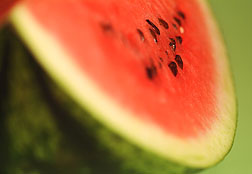
File this heart healthy fact away for next summer’s barbecue season: watermelon can help fight hypertension.
Florida State University gave nine prehypertensive study participants the amino acid L-citrulline/L-arginine from watermelon extract for six weeks and all of them exhibited improved arterial function and lower aortic blood pressure.
Watermelon is also a source of vitamins A, B6, C, fiber, potassium and the antioxidant lycopene. Antioxidants are vital to eye health and help to fight the free radical oxidation damage that causes eye diseases like macular degeneration.
Study author Arturo Figueroa highlights another condition that could benefit from daily watermelon intake: diabetes. “Individuals with increased blood pressure and arterial stiffness especially those who are older and those with chronic diseases such as type 2 diabetes would benefit from L-citrulline in either the synthetic or natural (watermelon) form,” he said. “The optimal dose appears to be four to six grams a day.”
Diabetes can lead to the eye condition diabetic retinopathy.
Learn more about nutrients in food that can treat and prevent disease.
Source: https://www.medicalnewstoday.com/articles/204527.php
 Watermelon is a great summer fruit, but it also has some powerful health benefits that you may not know about. The key nutrient in this tasty melon is lycopene, a carotenoid found in red fruits and vegetables, which is essential for eye health.
  In the case of choroidal neovascularization (CNV, also known as “wet” macular degeneration), new blood vessels are the cause of the problem. Yet normally when new blood vessels are created in the body, it is a good sign. For example, it is part of the way the body heals wounds. But with CNV, the blood vessels pose a problem because they originate in the choroid layer of the eye and pass through a weak part of the Bruch’s membrane, the innermost layer of choroid, then pass into the subretinal pigment epithelium (sub-RPE) or subretinal space. These blood vessels aren’t supposed to exist in this part of the eye, are weak and tend to leak, potentially substantially impairing vision.
 Excessive time spent in front of a computer, smartphone, or tablet screen can increase risk of macular degeneration, especially in young people.
 Research suggests that individuals with retinitis pigmentosa (RP) may benefit from a dietary iodine supplement. RP patients often experience retinal swelling as a result of Cystoid Macular Edema (CME). A study published in JAMA Ophthalmology showed swelling due to CME to be inversely related to iodine intake.
 Central Serous Choroidopathy, also known as Central Serous Retinopathy (CSR) and Central Serous Chorioretinopathy (CSC), is an eye condition which causes visual impairment. It usually occurs in one eye, and it is usually temporary. But studies show that both eyes are affected on a cellular level even when damage is only apparent in one eye.
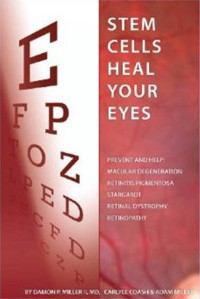 How can you prevent and reverse serious eye disease using stem cells? A new book by Damon P Miller II MD, Carlyle Coash MA, and Adam Miller examines the potential for stem cells to address macular degeneration, retinitis pigmentosa, Stargardt’s disease and other retinopathies. This up-and-coming area of medicine looks at research in Epigenetics and adult stem cells, and how they could help eye functioning.
 Eye infections are a result of invasion of any part of the eye by disease-causing microorganisms. These include certain pathogens that can invade the eyelid, the conjunctiva, the cornea and, in severe and serious cases, inner parts of the eye as well.