
 Blue light is emitted from all handheld electronic devices as well as desktop and laptop computers and televisions. It is the shortest wave length light in the visible spectrum and causes significant damage to many parts of the eye seriously impacting present and future vision capacity. Damage from blue light from smartphones is particularly important because smartphones are often used in dim light and are used close to the eyes. Unlike ordinary computer vision fatigue, damage from blue light is serious, cumulative and irreversible. Continue reading “Computers & Your Eyes II: How Blue Light Damages Vision”
Category: Carotenoids
How Carotenoid Supplementation Could Prevent Macular Degeneration and Alzheimer’s Disease
 Carotenoids have been shown to protect against oxidative damage, which can prevent both macular degeneration and factors contributing to dementia-related diseases (i.e., Alzheimer’s disease).[1. “Protective Effects of Dietary Supplementation with a Combination of Nutrients in a Transgenic Mouse Model of Alzheimer’s Disease” Shengyuan Wang et al., PLoS One. 2015; 10(11): e0143135. Published online 2015 Nov 25. doi: 10.1371/journal.pone.0143135 PMCID: PMC4659639] Links have been found between these two diseases: patients with dementia were found to have poor maculas and a higher incidence of Macular Degeneration[2. “Macular pigment, visual function, and macular disease among subjects with Alzheimer’s disease: an exploratory study.” Nolan JM et. al. J Alzheimers Dis. 2014;42(4):1191-202. doi: 10.3233/JAD-140507.].
However, these nutrients do not seem to be able to mitigate damage after dementia sets in. Therefore, making sure sufficient amounts of carotenoids are ingested at all ages Continue reading “How Carotenoid Supplementation Could Prevent Macular Degeneration and Alzheimer’s Disease”
Antioxidant Astaxanthin Helps Prevent AMD, Eye Fatigue & More
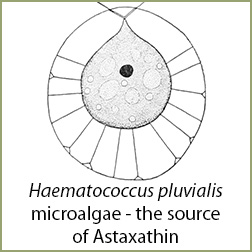 A humble micro-algae produces a powerful antioxidant: astaxanthin. It does so to protect itself from ultraviolet radiation. Research shows that astaxanthin protects the human eyes and brain from serious diseases such as age-related macular degeneration and dementia, including Alzheimer’s disease, as well as conditions like computer eye strain and eye fatigue (asthenopia)[3. https://www.naturaleyecare.com/study.asp?s_num=248]. Astaxanthin supplements are easy to take with no side effects. They are especially helpful as people age and begin to develop serious chronic conditions. Continue reading “Antioxidant Astaxanthin Helps Prevent AMD, Eye Fatigue & More”
Saffron Helps Macular Degeneration in Antioxidant Study
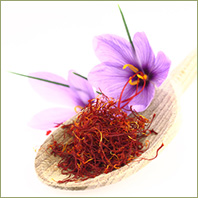 Taking saffron pills improved the visual acuity of age-related macular degeneration (AMD) patients in a small study. Macular degeneration is the gradual deterioration of the small, yellow-colored part of the eye near the center of the retina.
Saffron contains carotenoids called crocin and crocetin. These antioxidants have been shown to have a protective effect on retinal cells. Continue reading “Saffron Helps Macular Degeneration in Antioxidant Study”
Iritis – Minor Irritation or Major Warning?
 Iritis is a common diagnosis that literally means “inflammation of the iris,” the colored part of the eye. Anterior uveitis is a more technical term for iritis. There are many possible causes, and sometimes the cause cannot be identified. Due to the complexity of the vision system, any suspected case of eye inflammation should be examined by an optometrist, ophthalmologist or medical doctor. Most of the time, iritis resolves in less than 6 weeks; however, iritis can reoccur. It can signal acute or chronic underlying disease in the body, and therefore should be cared for by a qualified healthcare professional. Without proper treatment, iritis can lead to cataracts, glaucoma, an irregularly sized and sluggish pupil, calcium deposits in the cornea, central serous choroidopathy, or retinal swelling (cystoid macular edema). Continue reading “Iritis – Minor Irritation or Major Warning?”
Can Lycopene in Watermelon Prevent Macular Degeneration? (AMD)
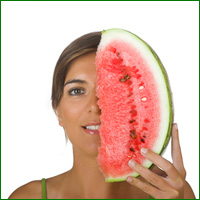 Watermelon is a great summer fruit, but it also has some powerful health benefits that you may not know about. The key nutrient in this tasty melon is lycopene, a carotenoid found in red fruits and vegetables, which is essential for eye health. Research has shown that a deficiency in lycopene is associated with macular degeneration. As such, it is important to maintain a diet rich in lycopene and other nutrients essential to preventing disease.
You’ve probably seen lycopene touted on bottles of tomato ketchup. It’s true that tomatoes are one source of lycopene, but ketchup Continue reading “Can Lycopene in Watermelon Prevent Macular Degeneration? (AMD)”
AMD Inhibited by Lutein, Carotenoids, and Zeaxanthin Antioxidants
 New evidence continues to support dietary lutein, carotenoids, zeaxanthin, and meso-zeaxanthin as a means of inhibiting development of age-related macular degeneration (AMD). AMD is the leading cause of loss of vision in Western people over age 55.
A study published in 2010, in Archives of Biochemistry and Biophysics by the Department of Ophthalmology and Visual Sciences at University of Utah, found that production of singlet oxygen in the human retinal pigment epithelium (RPE) and choroid is prevented or reduced by lutein, zeaxanthin, and meso-zeaxanthin, which act as Continue reading “AMD Inhibited by Lutein, Carotenoids, and Zeaxanthin Antioxidants”
Night Blindness Improved by Transplanted Photoreceptor Cells in Animal Experiment
 Transplanting light-sensitive photoreceptor cells into mice with night blindness resulted in improved night vision. Night blindness means seeing poorly in the darkness, but seeing normally when there is enough light. In this groundbreaking research, scientists injected light-sensitive photoreceptor cells into night-blind mice’s eyes. After this treatment, the animals were able to see well enough to navigate a water maze and swim toward a visual cue in dimly lit conditions. Controls who did not receive the treatment were unable to efficiently navigate the maze.
Continue reading “Night Blindness Improved by Transplanted Photoreceptor Cells in Animal Experiment”
Corneal Flash Burn Temporarily Blinds CNN Reporter Anderson Cooper
 Anderson Cooper, veteran reporter for the news channel CNN, was temporarily blinded by a flash corneal burn from excessive sun exposure while researching a news story in Portugal. He was not wearing sunglasses. The reporter’s eyesight returned after 36 hours.
The host of Anderson Cooper 360 and Anderson Live, Anderson Cooper spent time on a boat on a sunny, windy day without sunglasses. That night, he awoke with eye irritation and burning eye pain. “It [felt] like my eyes [were] on fire, my eye balls.” Then he discovered he was blinded. Cooper sought medical attention.
Continue reading “Corneal Flash Burn Temporarily Blinds CNN Reporter Anderson Cooper”
Stargardt’s Disease Vitamin A Contraindication
 Should you take extra Vitamin A if you have Stargardt’s Disease? Vitamin A supplementation is frequently recommended for certain eye diseases (AMD and Retinitis Pigmentosa, for example). This nutrient is crucial for rebuilding photoreceptors cells and proper retinal functioning. However, a study on mice published in “Investigative Ophthalmology and Visual Science” indicated that Stargardt’s Disease patients may be damaged by taking Vitamin A.
Continue reading “Stargardt’s Disease Vitamin A Contraindication”